CD2 Monoclonal Antibody (RM2-5), FITC, eBioscience™, Invitrogen™
Manufacturer: Fischer Scientific
Select a Size
| Pack Size | SKU | Availability | Price |
|---|---|---|---|
| Each of 1 | 50-935-1-Each-of-1 | In Stock | ₹ 31,506.00 |
50-935-1 - Each of 1
In Stock
Quantity
1
Base Price: ₹ 31,506.00
GST (18%): ₹ 5,671.08
Total Price: ₹ 37,177.08
Antigen
CD2
Classification
Monoclonal
Concentration
0.5 mg/mL
Formulation
PBS with 0.09% sodium azide; pH 7.2
Gene Accession No.
P08920
Gene Symbols
CD2
Purification Method
Affinity chromatography
Regulatory Status
RUO
Gene ID (Entrez)
12481
Content And Storage
4° C, store in dark, DO NOT FREEZE!
Form
Liquid
Applications
Flow Cytometry
Clone
RM2-5
Conjugate
FITC
Gene
CD2
Gene Alias
Cd2; CD2 antigen; CD2 antigen (p50), sheep red blood cell receptor; CD2 molecule; CD2R; cluster of differentiation 2; Erythrocyte receptor; FLJ46032; LFA2; LFA-2; LFA-3 receptor; Ly37; Ly-37; lymphocyte antigen 37; OX34; OX-34; OX-34 antigen; OX-45 surface antigen homolog to human T lymphocyte CD2 antigen; Rosette receptor; SRBC; surface immunoglobulin superfamily molecule; T11; T-cell surface antigen CD2; T-cell surface antigen T11/Leu-5
Host Species
Rat
Quantity
500 μg
Primary or Secondary
Primary
Target Species
Mouse
Product Type
Antibody
Isotype
IgG2b λ
Related Products


Description
- Description: The RM2-5 monoclonal antibody reacts with the mouse CD2 molecule, an approximately 50-55 kDa cell surface receptor expressed by all mouse lymphocytes
- Expression of the CD2 antigen in the mouse differs from that of the human in that B lineage cells in the mouse from the pre-B cell stage to mature B cells express CD2
- CD2 is a ligand for CD48 in the mouse and is involved in adhesion and activation of T cells
- Applications Reported: The RM2-5 antibody has been reported for use in flow cytometric analysis
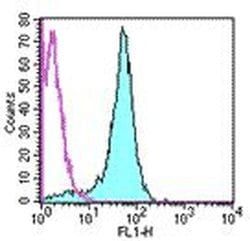
- Applications Tested: The RM2-5 antibody has been tested by flow cytometric analysis of mouse splenocytes and bone marrow cells
- This can be used at less than or equal to 0.25 μg per test
- A test is defined as the amount (μg) of antibody that will stain a cell sample in a final volume of 100 μL
- Cell number should be determined empirically but can range from 10^5 to 10^8 cells/test
- It is recommended that the antibody be carefully titrated for optimal performance in the assay of interest
- Excitation: 488 nm; Emission: 520 nm; Laser: Blue Laser
- Filtration: 0.2 μm post-manufacturing filtered
- CD2 (LFA-2) is a monomeric surface antigen (MW range 45-58 kDa) of the human T-lymphocyte lineage that is expressed on all peripheral blood T cells
- CD2 is one of the earliest T-cell markers, being present on more than 95% of thymocytes and it is also found on some natural killer cells, but not on B lymphocytes
- Monoclonal antibodies directed against CD2 inhibit the formation of rosettes with sheep erythrocytes, indicating that CD2 is the erythrocyte receptor or is closely associated with it
- The interaction between CD2 and CD58 stabilizes adhesion between T cells and antigen presenting or target cells
- Relatively low affinity of CD2 to CD58 (as measured in solution) is compensated within the two-dimensional cell-cell interface to provide tight adhesion
- Moreover, T cell activation induces increased CD2 expression and its lateral mobility, making easier contact between CD2 and CD58
- Subsequently, T cell activation causes fixation of CD58-CD2 at sites of cell-cell contact, thereby strengthening intercellular adhesion
- CD2 deficiency reduces intestinal inflammation and helps to control infection
- Diseases associated with CD2 dysfunction include penis squamous cell carcinoma and immune deficiency due to the absence of the thymus.