Glucagon Monoclonal Antibody (ICACLS), Alexa Fluor™ 488, eBioscience™, Invitrogen™
Manufacturer: Fischer Scientific
Select a Size
| Pack Size | SKU | Availability | Price |
|---|---|---|---|
| Each of 1 | 53-974-382-Each-of-1 | In Stock | ₹ 38,270.00 |
53-974-382 - Each of 1
In Stock
Quantity
1
Base Price: ₹ 38,270.00
GST (18%): ₹ 6,888.60
Total Price: ₹ 45,158.60
Antigen
Glucagon
Classification
Monoclonal
Concentration
0.5 mg/mL
Formulation
PBS with 0.09% sodium azide; pH 7.2
Gene Accession No.
P01275, P06883, P55095
Gene Symbols
Gcg
Purification Method
Affinity chromatography
Regulatory Status
RUO
Gene ID (Entrez)
14526, 24952, 2641
Content And Storage
4° C, store in dark, DO NOT FREEZE!
Form
Liquid
Applications
Immunohistochemistry (Paraffin)
Clone
ICACLS
Conjugate
Alexa Fluor 488
Gene
Gcg
Gene Alias
GCG; Glicentin; Glicentin-related polypeptide; GLP1; GLP-1; GLP-1(7-36); GLP-1(7-37); GLP1/2; GLP2; GLP-2; Glu; glucagon; Glucagon-like peptide 1; Glucagon-like peptide 1(7-36); Glucagon-like peptide 1(7-37); Glucagon-like peptide 2; glucagon-like peptide-1; GRPP; IL12p35; IL12P40; Incretin hormone; OXM; OXY; Oxyntomodulin; porcine proglucagon; PPG; preproglucagon; proglucagon
Host Species
Mouse
Quantity
100 μg
Primary or Secondary
Primary
Target Species
Human, Mouse, Rat
Product Type
Antibody
Isotype
IgG1 κ
Related Products


Description
- Description: This ICACLS monoclonal antibody reacts with human, mouse, and rat glucagon
- Glucagon is a peptide hormone secreted by the pancreatic alpha cells found within the islets of Langerhans
- Glucagon functions as an antagonist to insulin and homeostatic regulation of blood glucose levels are maintained by the critical balance between these two hormones
- Glucagon acts in the liver to convert glycogen to glucose by promoting gluconeogenesis and glycogenolysis
- Secretion of glucagon is stimulated by hypoglycemia, epinephrine, acetylcholine, and cholecystokinin, while secretion is inhibited by insulin and somatostatin
- Abnormally high levels of glucagon are found in pancreatic tumors
- Applications Reported: This ICACLS antibody has been reported for use in immunohistochemical staining, and immunohistochemical staining of formalin-fixed paraffin embedded tissue sections
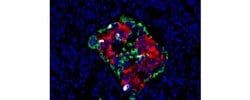
- Applications Tested: This ICACLS antibody has been tested by immunohistochemistry of formalin-fixed paraffin embedded human tissue using low pH antigen retrieval and can be used at less than or equal to 10 μg/mL
- It is recommended that the antibody be carefully titrated for optimal performance in the assay of interest
- Excitation: 488 nm; Emission: 519 nm; Laser: Blue Laser
- Filtration: 0.2 μm post-manufacturing filtered
- Glucagon is a 29-residue polypeptide hormone (MW 3482), produced in the pancreas
- A related hormone, enteroglucagon (or oxyntomodulin), which is produced in the mucosa of the small and large intestine, consists of the 29 amino acid sequence of pancreatic glucagon extended by 8 additional residues at the C-terminus
- The biological activities of pancreatic glucagon include glycogenolysis, lipolysis, gluconeogenesis, and ketogensis, which are antagonistic effects to those of insulin action, thus leading to increased blood glucose levels
- Immunocytochemical studies have revealed the presence of pancreatic glucagon inside the A or alpha cells, which constitute 15-20% of the islet cell population
- These cells are located preferentially at the periphery of the human pancreatic islets
- Pathological manifestations of the glucagon-type peptide residue almost exclusively with the exsistence of tumors or glucagonomas, as no states of glucagon-cell deficiency or hyperplasia have been identified
- Glucagon-specific antibodies would prove useful as a cell and tumor markers applying immunohistochemical techniques, and as an analytical tool in qualification of the hormone.