CD86 (B7-2) Monoclonal Antibody (IT2.2), Super Bright™ 436, eBioscience™, Invitrogen™
Manufacturer: Invitrogen
Select a Size
| Pack Size | SKU | Availability | Price |
|---|---|---|---|
| Each of 1 | 62-086-942-Each-of-1 | In Stock | ₹ 31,595.00 |
62-086-942 - Each of 1
In Stock
Quantity
1
Base Price: ₹ 31,595.00
GST (18%): ₹ 5,687.10
Total Price: ₹ 37,282.10
Antigen
CD86 (B7-2)
Classification
Monoclonal
Concentration
5 μL/Test
Formulation
PBS with BSA and 0.09% sodium azide; pH 7.2
Gene Accession No.
P42081
Gene Symbols
CD86
Purification Method
Affinity chromatography
Regulatory Status
RUO
Gene ID (Entrez)
942
Content And Storage
4° C, store in dark, DO NOT FREEZE!
Form
Liquid
Applications
Flow Cytometry
Clone
IT2.2
Conjugate
Super Bright 436
Gene
CD86
Gene Alias
activation B7-2 antigen; B lymphocyte activation antigen B72; B7; B7.2; B70; B7-2; B-lymphocyte activation antigen B7-2; BU63; CD28 antigen ligand 2; Cd28l2; CD28LG2; CD86; CD86 antigen; CD86 antigen (CD28 antigen ligand 2, B7-2 antigen); CD86 antigen precursor; CD86 molecule; CLS1; CTLA-4 counter-receptor B7.2; early T cell costimulatory molecule-1; early T-cell costimulatory molecule 1; Early T-cell co-stimulatory molecule 1; ETC-1; FUN-1; LAB72; Ly58; Ly-58; MB7; MB7-2; membrane glycoprotein; MGC34413; T-lymphocyte activation antigen CD86; TS/A-2
Host Species
Mouse
Quantity
100 Tests
Primary or Secondary
Primary
Target Species
Human
Product Type
Antibody
Isotype
IgG2b κ
Related Products



Description
- Description: The IT2.2 monoclonal antibody reacts with human CD86, an ∽80 kDa surface receptor also known as B7-2
- CD86 and CD80 are members of the B7 family of costimulatory molecules
- CD86 is expressed at low levels on B cells, macrophages, and dendritic cells and is upregulated on B cells through a variety of surface stimuli including the BCR complex, CD40 and some cytokine receptors
- In addition to CD80 (B7-1), CD86 is a counter-receptor for the T cell surface molecules CD28 and CD152 (CTLA-4)
- The interaction of CD86 with its ligands plays a critical role in T-B crosstalk, T cell costimulation, autoantibody production and Th2-mediated Ig production
- The kinetics of upregulation of CD86 upon stimulation supports its major contribution during the primary phase of an immune response
- Applications Reported: This IT2.2 antibody has been reported for use in flow cytometric analysis
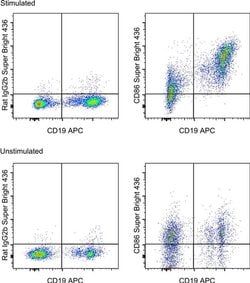
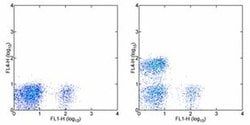
- Applications Tested: This IT2.2 antibody has been pre-titrated and tested by flow cytometric analysis of normal human peripheral blood cells
- This can be used at 5 μL (0.25 μg) per test
- A test is defined as the amount (μg) of antibody that will stain a cell sample in a final volume of 100 μL
- Cell number should be determined empirically but can range from 10^5 to 10^8 cells/test
- Super Bright 436 can be excited with the violet laser line (405 nm) and emits at 436 nm
- We recommend using a 450/50 bandpass filter, or equivalent
- CD86 is one of two ligands (the other CD80) for CTLA4 and CD28
- CD86 acts as costimulatory molecule in eliciting T-cell help during antigen presentation
- Antigen presentation in the absence of sufficient co-stimulation involving CD86/CD80 can induce tolerance
- CD80 appears to play a role distinct from CD80 in T helper cell differentiation
- CD86 is a type I membrane protein that is a member of the immunoglobulin superfamily
- The CD86 protein is expressed by antigen-presenting cells, and it is the ligand for two proteins at the cell surface of T cells, CD28 antigen and cytotoxic T-lymphocyte-associated protein 4
- Binding of CD86 with CD28 antigen is a costimulatory signal for activation of the T-cell
- Binding of CD86 with cytotoxic T-lymphocyte-associated protein 4 negatively regulates T-cell activation and diminishes the immune response
- Alternative splicing results in two transcript variants encoding different isoforms of CD86
- Additional transcript variants have been described for CD86, but their full-length sequences have not been determined
- Diseases associated with CD86 dysfunction include gallbladder squamous cell carcinoma and myocarditis.