CD172a (SIRP alpha) Monoclonal Antibody (15-414), Super Bright™ 436, eBioscience™, Invitrogen™
Manufacturer: eBioscience
Select a Size
| Pack Size | SKU | Availability | Price |
|---|---|---|---|
| Each of 1 | 62-172-942-Each-of-1 | In Stock | ₹ 32,307.00 |
62-172-942 - Each of 1
In Stock
Quantity
1
Base Price: ₹ 32,307.00
GST (18%): ₹ 5,815.26
Total Price: ₹ 38,122.26
Antigen
CD172a (SIRP alpha)
Classification
Monoclonal
Concentration
5 μL/Test
Formulation
PBS with BSA and 0.09% sodium azide; pH 7.2
Gene Accession No.
P78324
Gene Symbols
SIRPA
Purification Method
Affinity chromatography
Regulatory Status
RUO
Gene ID (Entrez)
140885
Content And Storage
4° C, store in dark, DO NOT FREEZE!
Form
Liquid
Applications
Flow Cytometry
Clone
15-414
Conjugate
Super Bright 436
Gene
SIRPA
Gene Alias
AI835480; Bit; brain Ig-like molecule with tyrosine-based activation motifs; Brain immunoglobulin like protein with tyrosine - based activation motifs; brain immunological-like with tyrosine-based motifs; brain-immunoglobulin-like molecule with tyrosine-based activation motifs; CD172; CD172 alpha; CD172 antigen-like family member A; CD172A; Inhibitory receptor SHPS-1; macrophage fusion receptor; Macrophage membrane protein MFP150; MFR; mSIRP-alpha1; Myd1; MYD-1; myD-1 antigen; p84; Protein tyrosine phosphatase non-receptor type substrate 1 (SHP substrate 1); protein tyrosine phosphatase, non-receptor type substrate 1; Protein tyrosine phosphatase, non-receptor type substrate 1 (SHP substrate 1); Ptpns1; SHP substrate 1; SHP-1; SHPS1; SHPS-1; signal regulatory protein alpha; signal-regulatory protein alpha; signal-regulatory protein alpha-1; Signal-regulatory protein alpha-2; Signal-regulatory protein alpha-3; SIRP; Sirpa; SIRPalpha; Sirp-alpha-1; SIRPalpha2; Sirp-alpha-2; Sirp-alpha-3; swc3; swine workshop cluster 3 antigen; swine workshop cluster 3 antigen precursor; tyrosine phosphatase SHP substrate 1; tyrosine-protein phosphatase non-receptor type substrate 1
Host Species
Mouse
Quantity
100 Tests
Primary or Secondary
Primary
Target Species
Human
Product Type
Antibody
Isotype
IgG2a κ
Related Products



Description
- Description: This 15-414 monoclonal antibody reacts with human CD172a, also known as signal regulatory protein alpha (SIRP alpha)
- This cell surface glycoprotein consists of three Ig-like extracellular domains and two cytoplasmic immunoreceptor tyrosine-based inhibitory motifs (ITIMs)
- The ITIM domains have been demonstrated to recruit and bind the Src homology 2 domain-containing phosphatases SHP-1 and SHP-2
- CD172a is expressed on monocytes, granulocytes, dendritic cells, and CD34+CD38- hematopoietic progenitor cells but not on T and B lymphocytes
- Moreover, neurons have also been shown to express CD172
- The integrin-associated protein CD47 is the extracellular ligand for CD172a
- Studies show that CD172a is involved in dendritic cell-mediated T cell activation, neutrophil migration, and phagocytosis
- Applications Reported: This 15-414 antibody has been reported for use in flow cytometric analysis
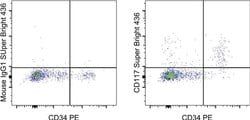
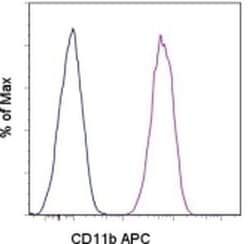
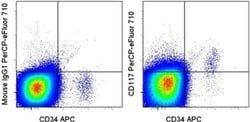
- Applications Tested: This 15-414 antibody has been pre-titrated and tested by flow cytometric analysis of normal human peripheral blood cells
- This can be used at 5 μL (0.5 μg) per test
- A test is defined as the amount (μg) of antibody that will stain a cell sample in a final volume of 100 μL
- Cell number should be determined empirically but can range from 10^5 to 10^8 cells/test
- Super Bright 436 can be excited with the violet laser line (405 nm) and emits at 436 nm
- We recommend using a 450/50 bandpass filter, or equivalent
- SIRP alpha (CD172a, signal-regulatory protein alpha) is a receptor-type transmembrane glycoprotein expressed on cells of myeloid origin, including granulocytes, dendritic cells (DCs), macrophages, mast cells and hematopoietic stem cells
- SIRP alpha acts as a substrate for several activated tyrosine kinases, including EGFR, PDGFR, src and insulin receptor and is involved in the negative regulation of receptor tyrosine kinase-coupled signaling pathways
- The ligand binding of SIRP alpha to integrin-associated protein CD47 results in tyrosine kinase phosphorylation of immunoreceptor tyrosine-based inhibitory motifs (ITIMs) within the cytoplasmic region of SIRP alpha, which mediates the recruitment and activation of the tyrosine phosphatases SHP-1 and SHP-2
- Ligation of SIRP alpha with CD47 has been demonstrated in several regulatory processes, including the inhibition of host cell phagocytosis by macrophages and the bi-directional activation of T cells and DCs
- SIRP alpha has regulatory effects on cellular responses induced by serum, growth factors, insulin, oncogenes, growth hormones and cell adhesion, and plays a general role in different physiological and pathological processes
- Cancer cells highly express CD47, which activates SIRP alpha and inhibits macrophage-mediated destruction of cancerous cell growth.