CD5 Monoclonal Antibody (UCHT2), Super Bright™ 600, eBioscience™, Invitrogen™
Manufacturer: Invitrogen
Select a Size
| Pack Size | SKU | Availability | Price |
|---|---|---|---|
| Each of 1 | 63-005-942-Each-of-1 | In Stock | ₹ 33,553.00 |
63-005-942 - Each of 1
In Stock
Quantity
1
Base Price: ₹ 33,553.00
GST (18%): ₹ 6,039.54
Total Price: ₹ 39,592.54
Antigen
CD5
Classification
Monoclonal
Concentration
5 μL/Test
Formulation
PBS with BSA and 0.09% sodium azide; pH 7.2
Gene Accession No.
P06127
Gene Symbols
Cd5
Purification Method
Affinity chromatography
Regulatory Status
RUO
Gene ID (Entrez)
921
Content And Storage
4° C, store in dark, DO NOT FREEZE!
Form
Liquid
Applications
Flow Cytometry
Clone
UCHT2
Conjugate
Super Bright 600
Gene
Cd5
Gene Alias
alanyl (membrane) aminopeptidase; alanyl aminopeptidase; alanyl aminopeptidase, membrane; aminopeptidase M; Aminopeptidase N; ANPEP; AP-M; APN; AP-N; CD antigen CD5; CD13; CD28; CD28 antigen (Tp44); CD28 molecule; Cd5; CD5 antigen; CD5 antigen (p56 62); CD5 antigen (p56-62); CD5 antigen p56-62; CD5 molecule; CD5 protein; CD74 antigen, invariant polypeptide of major; cell surface protein; costimulatory molecule B7 receptor CD28; fCD5; GP150; hAPN; LAP1; LEU1; Ly-1; Ly12; Ly-12; LyA; Ly-A; Lymphocyte antigen 1; Lymphocyte antigen CD5; lymphocyte antigen T1/Leu-1; Lyt-1; membrane alanyl aminopeptidase; microsomal aminopeptidase; Myeloid plasma membrane glycoprotein CD13; P150; Pan T cell; PEPN; T1; T-cell costimulatory molecule CD28; T-cell surface glycoprotein CD5; T-cell-specific surface glycoprotein CD28; unnamed protein product
Host Species
Mouse
Quantity
100 Tests
Primary or Secondary
Primary
Target Species
Human
Product Type
Antibody
Isotype
IgG1 κ
Related Products



Description
- Description: The UCHT2 monoclonal antibody reacts with human CD5, a 67 kDa protein expressed by a majority of thymocytes and mature T cells and a subset of B cells
- Signaling through the CD5 molecule activates T cells and binding of CD5 to its ligand on B cells, CD72, and plays an important role in T-B interaction and proliferation
- The monoclonal antibody UCHT2 recognizes primate CD5
- Applications Reported: This UCHT2 antibody has been reported for use in flow cytometric analysis
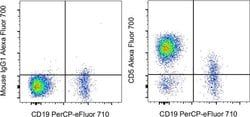
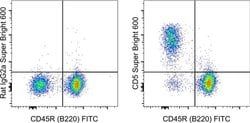
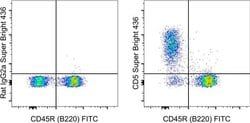
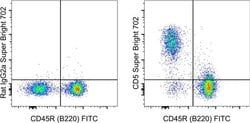
- Applications Tested: This UCHT2 antibody has been pre-diluted and tested by flow cytometric analysis of normal human peripheral blood cells
- This may be used at 5 μL (0.5 μg) per test
- A test is defined as the amount (μg) of antibody that will stain a cell sample in a final volume of 100 μL
- Cell number should be determined empirically but can range from 10^5 to 10^8 cells/test
- Super Bright 600 is a tandem dye that can be excited with the violet laser line (405 nm) and emits at 600 nm
- We recommend using a 610/20 bandpass filter
- Please make sure that your instrument is capable of detecting this fluorochrome
- When using two or more Super Bright dye-conjugated antibodies in a staining panel, it is recommended to use Super Bright Staining Buffer (Product No
- SB-4400) to minimize any non-specific polymer interactions
- Please refer to the datasheet for Super Bright Staining Buffer for more information
- CD5 is a 67 kDa human T-lymphocyte single-chain transmembrane glycoprotein
- CD5 is present on all mature T-lymphocytes, on most of thymocytes and on many T-cell leukemias and lymphomas
- CD5 also reacts with a subpopulation of activated B-cells and may act as a receptor in regulating T-cell proliferation
- CD5 is found on 95% of thymocytes and 72% of peripheral blood lymphocytes
- In lymph nodes, the main reactivity is observed in T cell areas
- CD5 is expressed by many T cell leukemia, lymphomas, and activated T cells
- Diseases associated with CD5 dysfunction include thymus cancer and Richter's Syndrome.