70-162-9RP488
DYKDDDDK Tag Recombinant Rabbit Monoclonal Antibody (8H8L17), Alexa Fluor™ Plus 488, Invitrogen™
Manufacturer: Fischer Scientific
Select a Size
| Pack Size | SKU | Availability | Price |
|---|---|---|---|
| Each of 1 | 70-162-9RP488-Each-of-1 | In Stock | ₹ 35,600.00 |
70-162-9RP488 - Each of 1
In Stock
Quantity
1
Base Price: ₹ 35,600.00
GST (18%): ₹ 6,408.00
Total Price: ₹ 42,008.00
Antigen
DYKDDDDK Tag
Classification
Recombinant Monoclonal
Concentration
1.0 mg/mL
Formulation
proprietary buffer with 0.008% Bromonitrodioxane, 0.008% Methylisothiazolone, pH 6.5
Host Species
Rabbit
Purification Method
Protein A
Regulatory Status
RUO
Target Species
Tag
Form
Liquid
Target Molecule
Tag
Applications
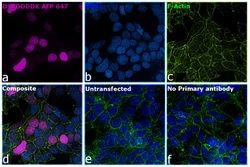
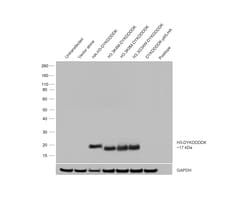
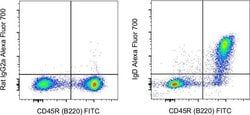
Flow Cytometry, Immunocytochemistry, Western Blot
Clone
8H8L17
Conjugate
Alexa Fluor Plus 488
Gene Alias
DDDDK, DDDDK epitope tag, ECS epitope tag, ECS tag, FLAG, FLAG Tag
Immunogen
Synthetic peptide (DYKDDDDK)
Quantity
50 μg
Primary or Secondary
Primary
Content And Storage
4° C, store in dark, DO NOT FREEZE!
Isotype
IgG
Related Products
Description
- DYKDDDDK tag, also known as FLAG tag, is a short peptide sequence that is commonly used as a protein tag to facilitate protein purification, detection, and localization
- The tag consists of eight amino acids: Asp-Tyr-Lys-Asp-Asp-Asp-Asp-Lys
- It is often fused to the N- or C-terminus of a protein of interest, allowing for easy identification and isolation of the protein using anti-FLAG antibodies
- The DYKDDDDK tag is widely used in molecular biology and biochemistry research, and has been employed in various applications, such as protein-protein interaction studies, protein expression analysis, and protein localization studies
- The FLAG tag structure has been optimized for compatibility with the proteins it is attached to, in that it is more hydrophilic than other common epitope tags and therefore less likely to denature or inactivate proteins to which it is appended
- FLAG is a registered trademark of Merck KGaA, Darmstadt, Germany.