7068261
IgM Monoclonal Antibody (eB121-15F9), FITC, eBioscience™, Invitrogen™
Rat Monoclonal Antibody
Manufacturer: Fischer Scientific
The price for this product is unavailable. Please request a quote
Antigen
IgM
Concentration
0.5 mg/mL
Classification
Monoclonal
Form
Liquid
Regulatory Status
RUO
Formulation
PBS with 0.09% sodium azide; pH 7.2
Gene Alias
AGM1; AI326478; Igh6; Igh-6; Ighm; Igh-M; Igm; immunoglobulin heavy constant mu; MU; muH; VH
Gene Symbols
Ighm
Primary or Secondary
Primary
Content And Storage
4° C, store in dark, DO NOT FREEZE!
Gene
Ighm
Clone
eB121-15F9
Applications
Flow Cytometry
Conjugate
FITC
Host Species
Rat
Target Species
Mouse
Gene Accession No.
P01872
Gene ID (Entrez)
16019
Isotype
IgG2a κ
Purification Method
Affinity chromatography
Product Type
Antibody
Related Products



Description
- Description: The eB121-15F9 monoclonal antibody reacts with the mu heavy chain of mouse IgM
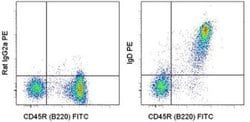
- It does not react with other classes of mouse immunoglobulin including IgD, IgG or IgA
- IgM is expressed intracellularly, during early stages of B lymphopoiesis, and then on the surface of more mature B cells in the bone marrow and peripheral B cells
- Fluorochrome conjugated eB121-15F9 can be used as a detection secondary for mouse IgM
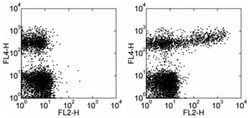
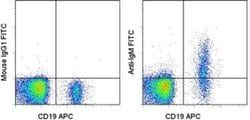
- Applications Reported: eB121-15F9 has been reported for use in flow cytometric analysis to detect the surface IgM on mouse B cells and as a second step to detect primary mouse IgMs
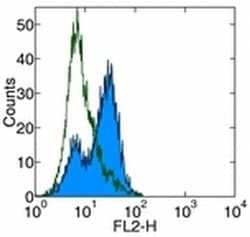
- Applications Tested: The eB121-15F9 antibody has been tested by flow cytometric analysis to detect the surface IgM on mouse B cells and can be used at less than or equal to 0.5 μg per test
- A test is defined as the amount (μg) of antibody that will stain a cell sample in a final volume of 100 μL
- Cell number should be determined empirically but can range from 10^5 to 10^8 cells/test
- It is recommended that the antibody be carefully titrated for optimal performance in the assay of interest
- Excitation: 488 nm; Emission: 520 nm; Laser: Blue Laser
- Filtration: 0.2 μm post-manufacturing filtered
- Mouse IgM is an immunoglobulin M antibody that is produced by B cells in response to an antigen
- It is the first antibody produced during an immune response and is the largest immunoglobulin in the serum
- Mouse IgM is composed of five heavy chains and five light chains, and it is involved in complement activation and agglutination of antigens
- It plays a crucial role in the innate immune response and is important for neutralizing pathogens before the adaptive immune response is fully activated
- Mouse IgM is widely used in research and diagnostic applications, including ELISA, Western blotting, and immunohistochemistry.