FceR1 alpha Monoclonal Antibody (MAR-1), PE, eBioscience™, Invitrogen™
Armenian Hamster Monoclonal Antibody
Manufacturer: Fischer Scientific
The price for this product is unavailable. Please request a quote
Antigen
FceR1 alpha
Concentration
0.2 mg/mL
Classification
Monoclonal
Form
Liquid
Regulatory Status
RUO
Formulation
PBS with 0.09% sodium azide; pH 7.2
Gene Alias
alpha polypeptide; fc epsilon r1; Fc epsilon receptor Ia; Fc epsilon RI alpha-chain; Fc fragment of IgE receptor Ia; Fc fragment of IgE, high affinity I, receptor for; alpha polypeptide; Fc IgE receptor, alpha polypeptide; Fc receptor, IgE, high affinity I, alpha polypeptide; Fce1a; Fc-epsilon RI-alpha; fcepsilonri; FCER1A; FcERI; Fcr-5; high affinity immunoglobulin epsilon receptor alpha-subunit; high affinity immunoglobulin epsilon receptor subunit alpha; IgE Fc receptor subunit alpha; Iger01; immunoglobulin E receptor, high-affinity, of mast cells, alpha polypeptide; RATIGER01; RP11-550P17.3
Gene Symbols
FCER1A
Primary or Secondary
Primary
Content And Storage
4° C, store in dark, DO NOT FREEZE!
Gene
FCER1A
Clone
MAR-1
Applications
Flow Cytometry
Conjugate
PE
Host Species
Armenian Hamster
Target Species
Mouse
Gene Accession No.
P20489
Gene ID (Entrez)
14125
Isotype
IgG
Purification Method
Affinity chromatography
Product Type
Antibody
Related Products




Description
- Description: The MAR-1 monoclonal antibody reacts with the Fc epsilon Receptor I alpha subunit, an IgE-binding subunit lacking signal-transducing ability
- Fc epsilon RI alpha is expressed on mast and basophil cells and is up-regulated by the presence of IgE
- Fc epsilon RI alpha forms a tetrameric complex with one beta and two gamma subunits
- The beta and gamma subunits possess immunoreceptor tyrosine-based activation motifs (ITAM)
- The Fc epsilon RI complex plays an important role in triggering IgE-mediated allergic reactions
- Applications Reported: The MAR-1 antibody has been reported for use in flow cytometric analysis
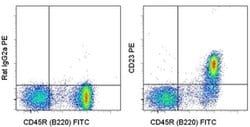
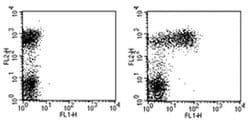
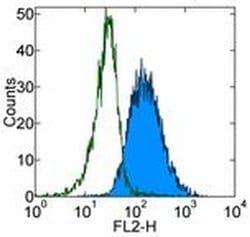
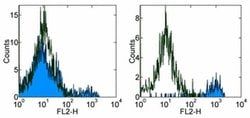
- Applications Tested: The MAR-1 antibody has been tested by flow cytometric analysis of the MC/9 cell line (a mouse mast cell line)
- This can be used at less than or equal to 0.06 μg per test
- A test is defined as the amount (μg) of antibody that will stain a cell sample in a final volume of 100 μL
- Cell number should be determined empirically but can range from 10^5 to 10^8 cells/test
- It is recommended that the antibody be carefully titrated for optimal performance in the assay of interest
- Excitation: 488-561 nm; Emission: 578 nm; Laser: Blue Laser, Green Laser, Yellow-Green Laser
- Filtration: 0.2 μm post-manufacturing filtered
- FceR1 (Fc epsilonR1 alpha) is a subunit of the high affinity receptor of IgE
- Fc epsilonR1 alpha is a tetrameric complex consisting of one alpha, one β and two additional subunits
- The latter two are required for signal transduction activity
- The Fc epsilonR1 complex plays an important role in triggering allergic responses, and the immunoglobulin epsilon receptor (IgE receptor) is the initiator of the allergic response
- When two or more high-affinity IgE receptors are brought together by allergen-bound IgE molecules, mediators such as histamine, which are responsible for allergy symptoms, are released
- The IgE receptor couples allergen and mast cells to initiate the inflammatory responses that are characteristic of disorders such as hay fever and asthma
- The release of histamine and proteases leads to the synthesis of prostaglandins and leukotrienes-potent effectors of the hypersensitivity response.