7069128
TER-119 Monoclonal Antibody (TER-119), Biotin, eBioscience™, Invitrogen™
Rat Monoclonal Antibody
Manufacturer: Fischer Scientific
The price for this product is unavailable. Please request a quote
Antigen
TER-119
Concentration
0.5 mg/mL
Classification
Monoclonal
Form
Liquid
Regulatory Status
RUO
Formulation
PBS with 0.09% sodium azide; pH 7.2
Gene Alias
Ly76; Ly-76; TER119
Gene Symbols
Ly76
Primary or Secondary
Primary
Content And Storage
4° C, store in dark, DO NOT FREEZE!
Gene
Ly76
Clone
TER-119
Applications
Flow Cytometry
Conjugate
Biotin
Host Species
Rat
Target Species
Mouse
Gene Accession No.
0
Gene ID (Entrez)
104231
Isotype
IgG2b κ
Purification Method
Affinity chromatography
Product Type
Antibody
Related Products


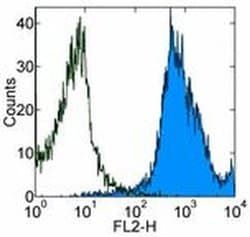
Description
- Description: The TER-119 monoclonal antibody reacts with mouse erythroid cells from early proerythroblast to mature erythrocyte stages
- The TER-119 antigen is present in yolk sac, fetal and newborn liver, but is not expressed by cells carrying BFU-E and CFU-E activities
- Several erythroleukemia cell lines tested so far are negative for expression of TER-119 antigen even after dimethylsulfoxide stimulation
- Biochemical and molecular analysis of the TER-119 antigen indicate that this molecule is associated with the surface glycophorin A, but is not a typical glycophorin
- Applications Reported: The TER-119 antibody has been reported for use in flow cytometric analysis
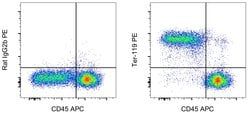
- Applications Tested: The TER-119 antibody has been tested by flow cytometric analysis of mouse splenocytes and bone marrow cells
- This can be used at less than or equal to 0.5 μg per test
- A test is defined as the amount (μg) of antibody that will stain a cell sample in a final volume of 100 μL
- Cell number should be determined empirically but can range from 10^5 to 10^8 cells/test
- It is recommended that the antibody be carefully titrated for optimal performance in the assay of interest
- Filtration: 0.2 μm post-manufacturing filtered
- TER-119 is a lineage marker for erythroid cells from early proerythroblast to mature erythrocyte stages in adult blood, spleen, and bone marrow
- It is also present in yolk sac, and fetal and newborn liver
- The TER-119 antigen is not expressed by cells of earlier erythroid development at BFU-e (blast-forming unit erythroid) stage or CFU-e (colony-forming unit erythroid) stage.