Ub-K63 Monoclonal Antibody (HWA4C4), eBioscience™, Invitrogen™
Mouse Monoclonal Antibody
Manufacturer: Fischer Scientific
The price for this product is unavailable. Please request a quote
Antigen
Ub-K63
Concentration
0.5 mg/mL
Classification
Monoclonal
Form
Liquid
Regulatory Status
RUO
Formulation
PBS with 0.09% sodium azide; pH 7.2
Gene Alias
0610006J14Rik; 2700054O04Rik; 40S ribosomal protein S27a; 60S ribosomal protein L40; AI194771; AL033289; CEP52; CEP80; D8Ertd21e; epididymis luminal protein 112; epididymis secretory protein Li 50; Gm1863; HEL112; HEL-S-50; HMG20; HUBCEP52; L40; Large ribosomal subunit protein eL40; LOC100912032; polyubiquitin B; polyubiquitin C; polyubiquitin-B; Polyubiquitin-C; ribosomal protein S27A; RPL40; Rps27a; S27A; Small ribosomal subunit protein eS31; TI-225; Uba52; UBA80; Ubb; Ubb2; UBC; UBCEP1; UBCEP2; UBCEP80; Ubiquitin; Ubiquitin A-52 residue ribosomal protein fusion product 1; ubiquitin and ribosomal protein S27a; ubiquitin B; ubiquitin C; ubiquitin carboxyl extension protein 52; ubiquitin carboxyl extension protein 80; ubiquitin/60S ribosomal fusion protein; Ubiquitin-40S ribosomal protein S27a; ubiquitin-40S ribosomal protein S27a-like; ubiquitin-52 amino acid fusion protein; ubiquitin-60S ribosomal protein L40; ubiquitin-CEP52; ubiquitin-CEP80; Ubiquitin-related; Ubiquitin-related 1; Ubiquitin-related 2
Gene Symbols
RPS27A, UBA52, UBB, UBC
Primary or Secondary
Primary
Content And Storage
4° C
Clone
HWA4C4
Applications
Western Blot
Conjugate
Unconjugated
Host Species
Mouse
Target Species
Human
Gene Accession No.
P0CG47, P0CG48, P62979, P62987
Gene ID (Entrez)
6233, 7311, 7314, 7316
Isotype
IgG2a
Purification Method
Affinity chromatography
Product Type
Antibody
Related Products



Description
- Description: Ubiquitin is a highly conserved 76kDa protein which is ligated to many proteins in both monomeric and polymeric forms
- Ubiquitin polymers (polyubiquitin) can be found in several varieties depending on which of its 7 lysine residues is the site of ligation
- The two most common polymer chains are linked via an isopeptide bond between glycine-76 and either lysine-48 (K-48) or lysine-63 (K-63)
- K-48-linked polyubiquitination typically results in targeting the protein to the 26S proteosome resulting in proteolysis, although recently exceptions to this have been observed
- In contrast, K-63-linked polyubiquitination results in signals related to intracellular trafficking, cell signaling, ribosomal biogenesis, and DNA damage repair
- There are also reports that K63-linked polyubiquitin is involved in proteosome-independent proteolysis via autophagy
- HWA4C4 reacts specifically with the isopeptide linkage region of lysine-63-linked polyubiquitin
- It does not react with other forms of ubiquitin including ubiquitin monomer and lysine-48-linked chains
- Applications Reported: This HWA4C4 antibody has been reported for use in immunoblotting (WB)
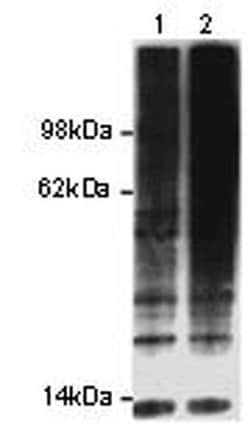
- Applications Tested: This HWA2-8°C4 antibody has been tested by immunoblot of lysine-63-linked polyubiquitin chains
- This can be used at less than or equal to 2 μg/mL
- It is recommended that the antibody be carefully titrated for optimal performance in the assay of interest
- Ubiquitin is a conserved 76 amino acid polypeptide and can affect proteasomal degradation of the protein it is bound to, or mediate interactions with other proteins related to post-translational modifications
- The degradation of cellular regulatory proteins by the Uubiquitin pathway is important as it controls the cellular growth and proliferation
- Ubiquitin-dependent proteolysis occurs after a covalent attachment of the peptide to a lysine residue of a protein, which involves three enzymatic reactions: E1, E2 and E3
- The first reaction involves ubiquitin-activating enzyme
- The third reaction uses enzyme ubiquitin ligase (E3) to transfer the activated ubiquitin from E2 to a lysine residue on a protein, or directly transfers the ubiquitin from E2 to the substrate.