CD11a (LFA-1alpha) Monoclonal Antibody (M17/4), Functional Grade, eBioscience™, Invitrogen™
Rat Monoclonal Antibody
Manufacturer: Fischer Scientific
The price for this product is unavailable. Please request a quote
Antigen
CD11a (LFA-1alpha)
Concentration
1 mg/mL
Classification
Monoclonal
Form
Liquid
Regulatory Status
RUO
Formulation
PBS with no preservative; pH 7.2
Gene Alias
(p180); alpha L integrin; antigen CD11A (p180); antigen CD11A (p180), lymphocyte function-associated antigen 1, alpha polypeptide; antigen CD11A p180; CD11 antigen-like family member A; CD11a; integrin alpha L; integrin alphaL; integrin alpha-L; integrin alpha-L precursor; integrin gene promoter; integrin subunit alpha L; integrin surface receptor; integrin, alpha L; integrin, alpha L (antigen CD11A (p180), lymphocyte function-associated antigen 1; alpha polypeptide); ITGAL; Leukocyte adhesion glycoprotein LFA-1 alpha chain; leukocyte function-associated molecule 1 alpha chain; LFA-1; LFA-1 alpha; LFA1A; LFA-1A; Ly-15; Ly-21; lymphocyte antigen 15; lymphocyte function associated antigen 1, alpha polypeptide; lymphocyte function-associated antigen 1; lymphocyte function-associated antigen 1, alpha polypeptide; lymphocyte function-associated antigen-1
Gene Symbols
ITGAL
Primary or Secondary
Primary
Content And Storage
4° C
Gene
ITGAL
Clone
M17/4
Applications
Control, Flow Cytometry, Functional Assay
Conjugate
Functional Grade
Host Species
Rat
Target Species
Mouse
Gene Accession No.
P24063
Gene ID (Entrez)
16408
Isotype
IgG2a κ
Purification Method
Affinity chromatography
Product Type
Antibody
Related Products



Description
- Description: The M17/4 monoclonal antibody reacts with mouse CD11a, the 180 kDa integrin alpha L, also known as the lymphocyte function associated antigen-1 (LFA-1) alpha chain
- LFA-1, formed by non-covalent association of CD11a with CD18 (integrin beta 2), serves as an important adhesion molecule involved in lymphocyte and granulocyte function
- CD54 (ICAM-1), CD102 (ICAM-2), and CD50 (ICAM-3) are ligands for LFA-1
- CD11a is expressed by all leukocytes
- Applications Reported: The M17/4 antibody has been reported for use in flow cytometric analysis
- M17/4 has also been reported in blocking of CD11a function
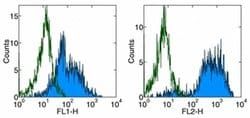
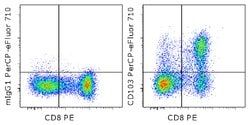
- Applications Tested: The M17/4 antibody has been tested by flow cytometric analysis of mouse splenocytes
- This can be used at less than or equal to 0.5 μg per test
- A test is defined as the amount (μg) of antibody that will stain a cell sample in a final volume of 100 μL
- Cell number should be determined empirically but can range from 10^5 to 10^8 cells/test
- It is recommended that the antibody be carefully titrated for optimal performance in the assay of interest
- Storage and handling: Use in a sterile environment
- Filtration: 0.2 μm post-manufacturing filtered
- Purity: Greater than 90%, as determined by SDS-PAGE
- Endotoxin Level: Less than 0.001 ng/μg antibody, as determined by LAL assay
- Aggregation: Less than 10%, as determined by HPLC
- CD11a (LFA-1 alpha, ITGAL) together with CD18 constitute leukocyte function-associated antigen 1 (LFA-1), the alphaLbeta2 integrin
- CD11a is implicated in activation of LFA-1 complex
- CD11a plays a central role in leukocyte intercellular adhesion through interactions with its ligands, ICAMs 1-3 (intercellular adhesion molecules 1 through 3), and also functions in lymphocyte costimulatory signaling
- CD11a is expressed on the plasma membrane of leukocytes in a low-affinity conformation
- Cell stimulation by chemokines or other signals leads to induction the high-affinity conformation, which supports tight binding of CD11a to its ligands, the intercellular adhesion molecules ICAM-1, -2, -3
- CD11a is thus involved in interaction of various immune cells and in their tissue-specific settlement, but participates also in control of cell differentiation and proliferation and of T-cell effector functions
- Blocking of CD11a function by specific antibodies or small molecules has become an important therapeutic approach in treatment of multiple inflammatory diseases
- For example, humanized anti- CD11a antibody Efalizumab (Raptiva) is being used to interfere with T cell migration to sites of inflammation, binding of cholesterol-lowering drug simvastatin to CD11a allosteric site leads to immunomodulation and increase in lymphocytic cholinergic activity
- Two transcript variants encoding different isoforms of CD11a have been found
- Diseases associated with CD11a dysfunction include benign cephalic histiocytosis and leukocyte adhesion deficiency.