CD80 (B7-1) Monoclonal Antibody (16-10A1), APC, eBioscience™, Invitrogen™
Armenian Hamster Monoclonal Antibody
Manufacturer: Fischer Scientific
The price for this product is unavailable. Please request a quote
Antigen
CD80 (B7-1)
Concentration
0.2 mg/mL
Classification
Monoclonal
Form
Liquid
Regulatory Status
RUO
Formulation
PBS with 0.09% sodium azide; pH 7.2
Gene Alias
Activation B7-1 antigen; B7; B7 protein; B7.1; B71; B7-1; B7-1 protein; B7-1 protein precursor; BB1; B-lymphocyte activation antigen B7; Cd28l; CD28LG; CD28LG1; CD80; Cd80 a rat homolog of the human CD28/CTLA - 4 ligand (B7-1); CD80 anitgen; CD80 antigen; CD80 antigen (CD28 antigen ligand 1, B7-1 antigen); Cd80 molecule; CD80 protein precursor; costimulatory factor CD80; costimulatory molecule variant IgV-CD80; CTLA-4 counter-receptor B7.1; LAB7; Ly53; Ly-53; MIC17; sCD 80; sCD80; secreted B7-1 protein precursor; soluble CD 80; soluble CD80; T-cell costimulatory molecule; T-cell co-stimulatory protein B7-1; T-lymphocyte activation antigen CD80; TS/A-1; TSA1
Gene Symbols
CD80
Primary or Secondary
Primary
Content And Storage
4° C, store in dark, DO NOT FREEZE!
Gene
CD80
Clone
16-10A1
Applications
Flow Cytometry
Conjugate
APC
Host Species
Armenian Hamster
Target Species
Canine, Mouse, Porcine
Gene Accession No.
Q00609
Gene ID (Entrez)
12519, 397161, 403765
Isotype
IgG
Purification Method
Affinity chromatography
Product Type
Antibody
Related Products
Description
- Description: The 16-10A1 monoclonal antibody reacts with mouse CD80 (B7-1), a 55 kDa member of the Ig superfamily
- CD80 is expressed by macrophages, dendritic cells and activated B cells
- In addition, activated T cells express this antigen
- CD80 has high affinity for binding to two T cell surface antigens, CD28 and CD152 (CTLA-4)
- The interaction of CD28 and CD152 with CD80 is crucial in T-B cell communication leading to activation of T and B cells, respectively
- Applications Reported: The 16-10A1 antibody has been reported for use in flow cytometric analysis
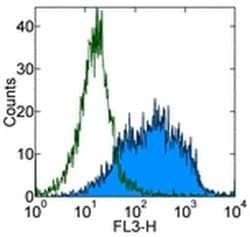
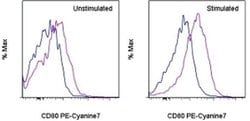
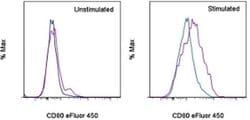
- Applications Tested: The 16-10A1 antibody has been tested by flow cytometric analysis of stimulated mouse splenocytes
- This can be used at less than or equal to 0.06 μg per test
- A test is defined as the amount (μg) of antibody that will stain a cell sample in a final volume of 100 μL
- Cell number should be determined empirically but can range from 10^5 to 10^8 cells/test
- It is recommended that the antibody be carefully titrated for optimal performance in the assay of interest
- Excitation: 633-647 nm; Emission: 660 nm; Laser: Red Laser
- Filtration: 0.2 μm post-manufacturing filtered
- CD80 (B7-1) and CD86 (B7-2) are ligands of T cell critical costimulatory molecule CD28, and of an inhibitory receptor CTLA-4 (CD152)
- Both B7 molecules are expressed on professional antigen-presenting cells and are essential for T cell activation, and both molecules can also substitute for each other in this process
- CD80 is rapidly induced on the surface of in vitro activated B cells, with Epstein Barr Virus (EBV) transformed B cell lines, with Burkitts lymphoma cell lines, with freshly isolated follicular B lymphoma cells, T cells, and monocytes
- The B-lymphocyte activation antigen B7-1 provides regulatory signals for T lymphocytes as a consequence of binding to the CD28 and CTLA4 ligands of T cells
- Diseases associated with CD80 dysfunction include gallbladder squamous cell carcinoma and myocarditis.