HLA-G Monoclonal Antibody (87G), APC, eBioscience™, Invitrogen™
Mouse Monoclonal Antibody
Manufacturer: Fischer Scientific
The price for this product is unavailable. Please request a quote
Antigen
HLA-G
Concentration
5 μL/Test
Classification
Monoclonal
Form
Liquid
Regulatory Status
RUO
Formulation
PBS with 0.2% BSA and 0.09% sodium azide; pH 7.2
Gene Alias
acrosomal protein SP-10; Acrosomal vesicle protein 1; ACRV1; b2 microglobulin; D11S4365; DADB-15K14.8; HLA class I histocompatibility antigen, alpha chain G; HLA class I molecule; HLA G antigen; HLA-6.0; HLAG; HLA-G; HLA-G histocompatibility antigen, class I, G; LOC768350; major histocompatibility complex, class I, G; MHC class I antigen G; MHC-G; MHCIY; MHC-like class I Y; sHLA-G; Soluble HLA class I histocompatibility antigen, alpha chain G; SP-10; SPACA2; sperm protein 10
Gene Symbols
HLA-G
Primary or Secondary
Primary
Content And Storage
4° C, store in dark, DO NOT FREEZE!
Gene
HLA-G
Clone
87G
Applications
Flow Cytometry
Conjugate
APC
Host Species
Mouse
Target Species
Human
Gene Accession No.
P17693
Gene ID (Entrez)
3135
Isotype
IgG2a κ
Purification Method
Affinity chromatography
Product Type
Antibody
Related Products


Description
- Description: The monoclonal antibody 87G recognizes human HLA-G, a member of the Human Leukocyte Antigen family but as part of the nonclassical MHC type involved in inhibiting immune reponses
- HLA-G has seven reported isoforms
- The antibody 87G recognizes both HLA-G1 and the solube HLA-G5
- Expression of HLA-G is found primarily in fetal trophoblast cells as they invade the maternal decidua thereby protecting the fetus from the maternal immune system
- Like the highly mitotic trophoblast, abundant HLA-G protein expression has been identified in some tumors, including melanoma, breast carcinoma and renal carcinoma as well as CLL, AML and B-CLL
- Some expression has also been found in pancreatic islets, erythroid and endothelial progenitors and the adult thymic medulla.HLA-G+ CD4 or CD8 cells have been identified in normal human peripheral blood and are thought to act as regulatory cells in that they are hypoproliferative with a unique cytokine profile differing from Tregs
- The receptors for HLA-G are CD85j/ILT2, CD85d/ILT4, and CD158
- Recent studies have shown a role for HLA-G in tolerance and maintece of transplanted organs
- Applications Reported: This 87G antibody has been reported for use in flow cytometric analysis
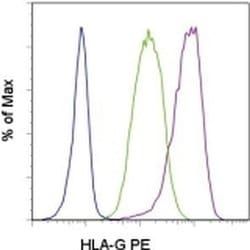
- Applications Tested: This 87G antibody has been pre-titrated and tested by flow cytometric analysis of stimulated U937 cells
- This can be used at 5 μL (0.125 μg) per test
- HLA-G belongs to the HLA class I heavy chain paralogues
- This class I molecule is a heterodimer consisting of a heavy chain and a light chain (beta-2 microglobulin)
- The heavy chain is anchored in the membrane
- HLA-G is expressed on fetal derived placental cells
- The heavy chain is approximately 45 kDa and its gene contains 8 exons
- Exon one encodes the leader peptide, exons 2 and 3 encode the alpha1 and alpha2 domain, which both bind the peptide, exon 4 encodes the alpha3 domain, exon 5 encodes the transmembrane region, and exon 6 encodes the cytoplasmic tail
- HLA and MHC antibodies play a significant role in Immunopeptidomics, facilitating the identification and characterization of neoantigens through high-performance liquid chromatography coupled to tandem Mass Spectrometry.