CD122 Monoclonal Antibody (TM-b1 (TM-beta1)), PE-Cyanine7, eBioscience™, Invitrogen™
Rat Monoclonal Antibody
Manufacturer: Fischer Scientific
The price for this product is unavailable. Please request a quote
Antigen
CD122
Concentration
0.2 mg/mL
Classification
Monoclonal
Form
Liquid
Regulatory Status
RUO
Formulation
PBS with 0.09% sodium azide; pH 7.2
Gene Alias
CD122; CD122 antigen; high affinity IL-2 receptor beta subunit; high affinity IL-2 receptor subunit beta; IL-15 receptor beta chain; IL15RB; IL15Rbeta; IL-15Rbeta; IL-2 receptor beta chain; IL-2 receptor subunit beta; IL-2/15 receptor-beta; Il-2/15Rbeta; IL-2R subunit beta; IL2RB; IL-2RB; IL2RBC; Il-2Rbeta; interleukin 15 receptor, beta; interleukin 2 receptor subunit beta; interleukin 2 receptor, beta; interleukin 2 receptor, beta chain; Interleukin-15 receptor subunit beta; Interleukin-2 receptor subunit beta; p70; p70-75; p75
Gene Symbols
Il2rb
Primary or Secondary
Primary
Content And Storage
4° C, store in dark, DO NOT FREEZE!
Gene
Il2rb
Clone
TM-b1 (TM-beta1)
Applications
Flow Cytometry
Conjugate
PE-Cyanine7
Host Species
Rat
Target Species
Mouse
Gene Accession No.
P16297
Gene ID (Entrez)
16185
Isotype
IgG2b κ
Purification Method
Affinity chromatography
Product Type
Antibody
Related Products
Description
- Description: The TM-b1 monoclonal antibody reacts with mouse CD122, the 90-110 kDa interleukin-2 receptor beta chain (IL-2R beta)
- CD122 is expressed by NK cells and some T cells in the periphery, and is upregulated by activation
- CD122 associates with CD25 and CD132 (common gamma chain) to form the high affinity IL-2 receptor
- High affinity binding of IL-2 to the IL-2 receptor is inhibited by the TM-b1 antibody
- Applications Reported: This TM-b1 (TM-beta1) antibody has been reported for use in flow cytometric analysis
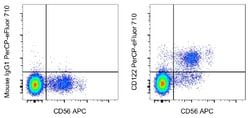
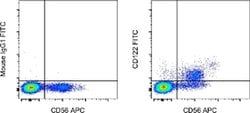
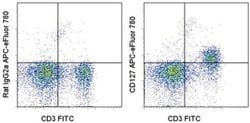
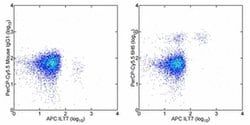
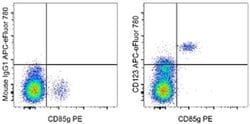
- Applications Tested: This TM-b1 (TM-beta1) antibody has been tested by flow cytometric analysis of mouse splenocytes
- This can be used at less than or equal to 0.25 μg per test
- A test is defined as the amount (μg) of antibody that will stain a cell sample in a final volume of 100 μL
- Cell number should be determined empirically but can range from 10^5 to 10^8 cells/test
- It is recommended that the antibody be carefully titrated for optimal performance in the assay of interest
- Light sensitivity: This tandem dye is sensitive to photo-induced oxidation
- Please protect this vial and stained samples from light
- Fixation: Samples can be stored in IC Fixation Buffer (cat
- 00-8222) (100 μL of cell sample + 100 μL of IC Fixation Buffer) or 1-step Fix/Lyse Solution (cat
- 00-5333) for up to 3 days in the dark at 4°C with minimal impact on brightness and FRET efficiency/compensation
- CD122 (Interleukin 2 receptor) is involved in T cell-mediated immune responses, primarily expressed in the hematopoietic system and is present in 3 forms
- The low affinity form of CD122 is a monomer of the alpha subunit and is not involved in signal transduction
- The intermediate affinity form consists of an alpha/beta subunit heterodimer, while the high affinity form consists of an alpha/beta/gamma subunit heterotrimer
- Both the intermediate and high affinity forms of the receptor are involved in receptor-mediated endocytosis and transduction of mitogenic signals from CD122
- The protein encoded by the CD122 gene represents the beta subunit and is a type I membrane protein
- Diseases associate with CD122 protein dysfunction include oligoarticular juvenile idiopathic arthritis and rheumatoid factor negative juvenile idiopathic arthritis.