AIRE Monoclonal Antibody (5H12), eFluor™ 660, eBioscience™, Invitrogen™
Rat Monoclonal Antibody
Manufacturer: Fischer Scientific
The price for this product is unavailable. Please request a quote
Antigen
AIRE
Concentration
0.2 mg/mL
Classification
Monoclonal
Form
Liquid
Regulatory Status
RUO
Formulation
PBS with 0.09% sodium azide; pH 7.2
Gene Alias
Aire; AIRE protein; AIRE1; APECED; APECED protein; APECED protein homolog; APS1; APSI; Autoimmune polyendocrinopathy candidiasis ectodermal dystrophy protein; autoimmune polyendocrinopathy candidiasis ectodermal dystrophy protein homolog; Autoimmune regulator; autoimmune regulator (autoimmune polyendocrinopathy candidiasis ectodermal dystrophy); autoimmune regulator AIRE1a; LOW QUALITY PROTEIN: autoimmune regulator; OTTHUMP00000109529; PGA1
Gene Symbols
Aire
Primary or Secondary
Primary
Content And Storage
4° C, store in dark, DO NOT FREEZE!
Gene
Aire
Clone
5H12
Applications
Flow Cytometry, Immunocytochemistry, Immunohistochemistry (Frozen)
Conjugate
eFluor 660
Host Species
Rat
Target Species
Mouse
Gene Accession No.
Q9Z0E3
Gene ID (Entrez)
11634
Isotype
IgG2c κ
Purification Method
Affinity chromatography
Product Type
Antibody
Related Products



Description
- Description: This 5H12 monoclonal antibody reacts with mouse Autoimmune Regulator (AIRE)
- This 58-kDa transcription factor is highly expressed within the perinuclear region of mature medullary thymic epithelial cells (mTECs)
- However, expression of AIRE protein in the periphery remains unclear despite the detection of AIRE mRNA in the lymph node, lymphoid stromal cells, monocytes, and dendritic cells
- Studies demonstrate that AIRE is involved in thymocyte development, in particular the regulation of tissue-specific antigen expression during negative selection
- Other biological functions for AIRE include chemokine expression and antigen presentation
- The 5H12 antibody recognizes mouse AIRE isoforms 1 and 2
- Applications Reported: This 5H12 antibody has been reported for use in intracellular flow cytometric analysis and immunohistochemical staining of frozen tissue sections
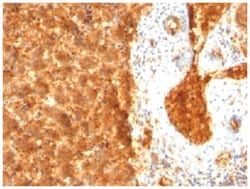
- Applications Tested: This 5H12 antibody has been tested by immunohistochemistry on frozen 5-week-old mouse thymus and can be used at less than or equal to 10 μg/mL
- It is recommended that the antibody be carefully titrated for optimal performance in the assay of interest
- eFluor™ 660 is a replacement for Alexa Fluor™ 647
- eFluor™ 660 emits at 659 nm and is excited with the red laser (633 nm)
- Please make sure that your instrument is capable of detecting this fluorochome
- Excitation: 633-647 nm; Emission: 668 nm; Laser: Red Laser
- Filtration: 0.2 μm post-manufacturing filtered
- AIRE is a transcriptional regulator protein that binds to DNA as a dimer and tetramer, but not as a monomer, and may be involved in the regulation of gene expression
- A nuclear protein, AIRE is a 545 amino acid protein with an HSR domain, two PHD type zinc fingers, and a SAND domain, and may be present in soluble high-molecular-weight complexes
- It may form homodimer, homotetramer and also nuclear bodies and interacts with the transcriptional coactivator CBP and CREBBP
- Three isoforms of AIRE are reported and one of them is predicted to be a candidate for nuclear-mediated decay (NMD)
- AIRE is involved in immune regulation and is known to mediate E3 ubiquitin ligase activity
- Defects in AIRE are responsible for the rare autosomal-recessive systemic autoimmune disease termed autoimmune polyendocrinopathy-candidiasis-ectodermal dystrophy (APECED).