7144378
BCAS3 Polyclonal Antibody, Bethyl Laboratories
Rabbit Polyclonal Antibody
Manufacturer: Fischer Scientific
The price for this product is unavailable. Please request a quote
Antigen
BCAS3
Classification
Polyclonal
Form
Liquid
Regulatory Status
RUO
Formulation
TBS with 0.1% BSA and 0.09% sodium azide
Gene Alias
Breast carcinoma-amplified sequence 3; GAOB1; Maab1 protein; BCAS3
Gene Symbols
BCAS3
Isotype
IgG
Purification Method
Antigen affinity chromatography
Product Type
Antibody
Applications
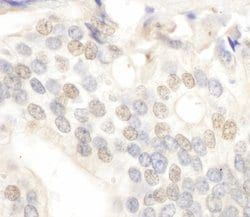
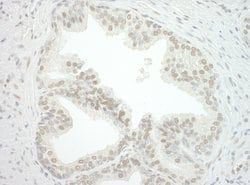
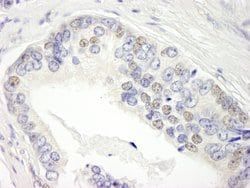
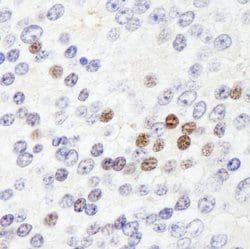
Immunohistochemistry
Conjugate
Unconjugated
Host Species
Rabbit
Target Species
Human
Gene Accession No.
Q9H6U6
Gene ID (Entrez)
54828
Immunogen
Between 870 and C-term
Primary or Secondary
Primary
Content And Storage
4° C
Gene
BCAS3
Related Products


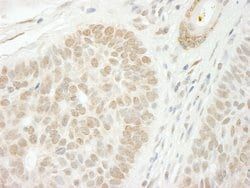
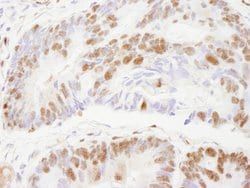
Description
- The recommended shelf life for this product is 1 year from date of receipt
- Based on 100% sequence identity, this antibody is predicted to react with Mouse, Orangutan, Monkey, Northern white-cheeked gibbon and Small-eared galago The Breast carcinoma amplified sequence (BCAS3) gene is localized to 17q23, a region that is often amplified in breast cancers
- Copy number gains at this region have also been reported in other tumors such as brain, lung, liver, testis and bladder
- BCAS3 is thought to be an estrogen receptor (ER)-alpha co-activator that acts through PELP1, another ER-alpha that in turn activates BCAS3 expression
- This may set up a positive feedback loop leading to ER-a signal amplification in the cell which may play a significant role in breast cancer
- BCAS3 expression has also been observed in embryonic stem cells and vascular precursors, suggesting that it may also play a role in embryogenesis and tumor angiogenesis.