7145162
TCR gamma/delta Monoclonal Antibody (eBioGL3 (GL-3, GL3)), Super Bright™ 780, eBioscience™, Invitrogen™
Armenian Hamster Monoclonal Antibody
Manufacturer: Fischer Scientific
The price for this product is unavailable. Please request a quote
Antigen
TCR gamma/delta
Concentration
0.2 mg/mL
Classification
Monoclonal
Form
Liquid
Regulatory Status
RUO
Formulation
PBS with BSA and 0.09% sodium azide; pH 7.2
Gene Alias
RGD1311300; similar to T cell receptor V delta 6; T cell receptor gamma locus; T3/TCR complex; TCR delta gamma; TCR gamma/delta; TCR-CD3 complex; Tcrg; Trg; Trg@
Gene Symbols
Tcrd, Tcrg
Primary or Secondary
Primary
Content And Storage
4° C, store in dark, DO NOT FREEZE!
Clone
eBioGL3 (GL-3, GL3), GL3)
Applications
Flow Cytometry
Conjugate
Super Bright 780
Host Species
Armenian Hamster
Target Species
Mouse
Gene Accession No.
0
Gene ID (Entrez)
110066, 110067
Isotype
IgG
Purification Method
Affinity chromatography
Product Type
Antibody
Related Products
Description
- Description: This DS5MMER monoclonal antibody recognizes mouse MerTK, a 170-210 kDa member of the TAM family of tyrosine kinase receptors that also includes Axl and Tyro3
- MerTK is expressed on tissue macrophages and is involved in the removal of apoptotic cells
- This process relies on two soluble ligands of MerTK, Protein S and Gas6 that bind to phosphatidylserine found on the outer leaflet of the plasma membrane of cells undergoing apoptosis
- Upon binding these ligands, MerTK undergoes autophosphorylation at multiple tyrosine residues that activate the PI3K and Akt pathways
- This results in the phagocytosis of apoptotic cells and also results in the direct inhibition of TLR-induced production of pro-inflammatory cytokines
- In addition, MerTK may function as a putative entry receptor for filoviruses
- Deficiency of MerTK causes general autoimmunity, inflammation and accumulation of apoptotic bodies
- MerTK is constitutively released from the cell surface by metalloproteinases and thus is present in the serum and culture medium
- This process can be enhanced by stimulation with LPS
- MerTK can be used to help discriminate macrophages from dendritic cells
- MerTK is often expressed on maligt cells and may be implicated in immune evasion
- The DS5MMER antibody will work on paraformaldehyde-fixed cells
- Applications Reported: This DS5MMER antibody has been reported for use in flow cytometric analysis
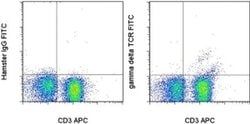
- TCR gamma/delta (T-cell receptor gamma/delta) are specialized T-cells in the immune system
- The ability of T cell receptors (TCR) to discriminate foreign from self-peptides presented by major histocompatibility complex (MHC) class II molecules is essential for an effective adaptive immune response
- TCR recognition of self-peptides has been linked to autoimmune disease
- Mutant self-peptides have been associated with tumors
- Engagement of TCRs by a family of bacterial toxins know as superantigens has been responsible for toxic shock syndrome
- Autoantibodies to V beta segments of T cell receptors have been isolated from patients with rheumatoid arthritis (RA) and systemic lupus erythematosus (SLE)
- The autoantibodies block TH1-mediated inflammatory auto-destructive reactions and are believed to be a method by which the immune system compensates for disease
- Most human T cells express the TCR alpha-beta and either CD4 or CD8 molecule (single positive, SP)
- However, a small number of T cells lack both CD4 and CD8 (double negative, DN)
- Increased percentages of alpha-beta DN T cells have been identified in some autoimmune and immunodeficiency disorders
- Gamma-delta T cells are primarily found within the epithelium
- They show less TCR diversity and recognize antigens differently than alpha-beta T cells
- Subsets of gamma-delta T cells have shown antitumor and immunoregulatory activity.