CD62P (P-Selectin) Monoclonal Antibody (Psel.KO2.3), Super Bright™ 600, eBioscience™, Invitrogen™
Mouse Monoclonal Antibody
Manufacturer: Fischer Scientific
The price for this product is unavailable. Please request a quote
Antigen
CD62P (P-Selectin)
Concentration
0.2 mg/mL
Classification
Monoclonal
Form
Liquid
Regulatory Status
RUO
Formulation
PBS with BSA and 0.09% sodium azide, pH 7.2
Gene Alias
CD62, CD62 antigen-like family member P, CD62P, CD62P antigen, CD62P, CD62 homolog, FLJ45155, GMP140, GMP-140, GMRP, Granule membrane protein 140, granule membrane protein 140kDa, granulocyte membrane protein, Grmp, LECAM3, leukocyte-endothelial cell adhesion molecule 3, PADGEM, Platelet activation dependent granule-external membrane protein, platelet alpha-granule membrane protein, PSEL, PSELECT, P-selectin, P-selectin precursor, RP1-86F14.2, selectin P, selectin P (granule membrane protein 140kDa, antigen CD62), selectin, platelet, Selp
Gene Symbols
SELP
Primary or Secondary
Primary
Content And Storage
4° C, store in dark, DO NOT FREEZE!
Gene
SELP
Clone
Psel.KO2.3
Applications
Flow Cytometry
Conjugate
Super Bright 600
Host Species
Mouse
Target Species
Human, Mouse
Gene Accession No.
P16109, Q01102
Gene ID (Entrez)
20344, 6403
Isotype
IgG1 κ
Purification Method
Affinity chromatography
Product Type
Antibody
Related Products
Description
- Description: The Psel.KO2.3 monoclonal antibody reacts with mouse CD62P (also known as P-selectin and GMP-140), a 140-kDa cell adhesion molecule that can be induced on endothelial cells and platelets
- During inflammation, this selectin mediates adhesion of monocytes and neutrophils to activated platelets, as well as leukocyte rolling on endothelial cells
- The major ligand for CD62P on neutrophils is P-selectin glycoprotein ligand-1 (PSGL-1)
- This monoclonal antibody recognizes an epitope that is conserved across several species (e.g
- mouse, human, and rat) and has not been reported to block cell adhesion
- Applications Reported: This Psel.KO2.3 antibody has been reported for use in flow cytometric analysis
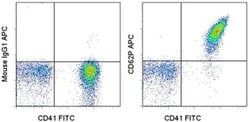
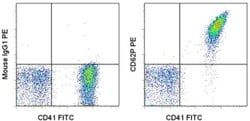
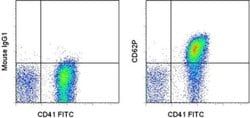
- Applications Tested: This Psel.KO2.3 antibody has been tested by flow cytometric analysis of thrombin-activated platelets
- This may be used at less than or equal to 0.5 μg per test
- A test is defined as the amount (μg) of antibody that will stain a cell sample in a final volume of 100 μL
- Cell number should be determined empirically but can range from 10^5 to 10^8 cells/test
- It is recommended that the antibody be carefully titrated for optimal performance in the assay of interest
- Super Bright 600 is a tandem dye that can be excited with the violet laser line (405 nm) and emits at 600 nm
- We recommend using a 610/20 bandpass filter
- Please make sure that your instrument is capable of detecting this fluorochrome
- P-selectin (Selectin P, GMP-140, LECAM3, CD62 antigen-like family member) is a 140 kDa type 1 transmembrane glycoprotein, and is one of the most commonly studied proteins that regulate cell rolling
- P-selectin is stored in the Weibel-Palade bodies of endothelial cells, as well as in a-granules of platelets
- From there, it can be rapidly brought to the cell surface after exposure to thrombin, histamine, complement 5a, Ca21 ionophores, or adenosine diphosphate
- P-selectin protein redistributes to the plasma membrane during platelet activation and degranulation and mediates the interaction of activated endothelial cells or platelets with leukocytes
- P-selectin plays an important role in adhesive processes between leucocytes and endothelial cells, and is a calcium dependent receptor that binds to sialylated forms of Lewis blood group carbohydrate antigens found on neutrophils and monocytes
- P-selectin is constitutively expressed in inflammation and contributes to atherogenesis, thrombosis and tissue destruction
- Clinically, P-selectin is used to distinguish heparin induced thrombocytopenia with and without thrombosis.