TNF p55 Receptor Polyclonal Antibody, Rockland™
Rabbit Polyclonal Antibody
Manufacturer: Fischer Scientific
The price for this product is unavailable. Please request a quote
Antigen
TNF p55 Receptor
Applications
ELISA, Immunoprecipitation, Western Blot
Conjugate
Unconjugated
Host Species
Rabbit
Target Species
Human
Gene Accession No.
P19438
Gene ID (Entrez)
7132
Immunogen
The whole rabbit serum used to produce this IgG fraction antibody was prepared by repeated immunizations with recombinant human sTNFRp55 expressed in Chinese Hamster Cells.
Content And Storage
-20°C, Avoid Freeze/Thaw Cycles
Gene
Tnfrsf1a
Concentration
1 mg/mL
Classification
Polyclonal
Form
Liquid
Regulatory Status
RUO
Formulation
0.02M potassium phosphate with 0.15M NaCl and 0.01% sodium azide; pH 7.2
Gene Alias
CD120a; CD120a antigen; FPF; LOC100346106; MGC19588; MS5; p55; p55 TNF receptor; p55-R; p60; p62; p63; sCD120a; soluble CD120a; soluble TNFR1; sTNF RI; sTNFR I; sTNFR1; sTNFRI; TBP1; TBPI; TNF receptor alpha chain; TNF receptor superfamily member 1A; TNF-alphaR1; TNF-alpha-R1; TNFalpha-R1; TNFAR; TNFR; TNF-R; TNFR I; TNFR1; TNF-R1; Tnfr-1; TNFR1-d2; Tnfr-2; TNFR55; TNF-R55; TNFR60; TNFRI; TNF-RI; TNF-R-I; TNFR-I; TNFRp55; TNFRSF1A; tumor necrosis factor binding protein 1; Tumor necrosis factor receptor; Tumor necrosis factor receptor 1; tumor necrosis factor receptor 1A isoform beta; tumor necrosis factor receptor 1-like; Tumor necrosis factor receptor superfamily member 1A; Tumor necrosis factor receptor superfamily member 1A, membrane form; tumor necrosis factor receptor superfamily, member 1A; tumor necrosis factor receptor type 1; Tumor necrosis factor receptor type I; tumor necrosis factor-alpha receptor; Tumor necrosis factor-binding protein 1
Gene Symbols
Tnfrsf1a
Primary or Secondary
Primary
Product Type
Antibody
Related Products



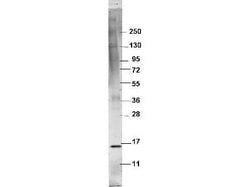
Description
- Store vial at -20°C prior to opening
- Aliquot contents and freeze at -20°C or below for extended storage
- Avoid cycles of freezing and thawing
- Centrifuge product if not completely clear after standing at room temperature
- This product is stable for several weeks at 4°C as an undiluted liquid
- Dilute only prior to immediate use
- This antibody is directed against the extracellular domain of the cell bound human TNFRp55
- In general, this antibody also detects primate sTNFRp55
- The antibody does not recognize human sTNFRp75
- In ELISA formats and other immunoreactive assays, this antibody will detect the extracellular domain of the TNFRp55 found in human body fluids, particularly in the circulation, urine and supernatants of cells and synovial fluid
- This antibody can be used for FACS analysis
- Caution should be exhibited as the F( c) domain of the rabbit IgG molecule may interact with cells non-specifically
- TNFR1 (Tumor necrosis factor receptor 1) belongs to the tumor necrosis factor superfamily, and is one of the major TNF-alpha receptors
- TNFR1 plays an important role in mediating, in cytokine mediated signaling, positive regulation of the NF-Kb pathway, positive regulation of angiogenesis, and negative regulation of gene expression
- The extracellular domain of TNFR1 is also released into the circulatory system as soluble TNFR1 (sTNFR1)
- In humans, the TNFR1 gene is located on chromosome 12
- Anti-apoptotic protein BCL2-associated athanogene 4 (BAG4/SODD) and adaptor proteins TRADD and TRAF2 have been shown to interact with TNFR1, and thus play regulatory roles in the signal transduction mediated by the receptor
- Germline mutations of the extracellular domains of TNFR1 were found to be associated with the autosomal dominant periodic fever syndrome, and the impaired receptor clearance is thought to be a mechanism of the disease.