Phospho-SRC (Tyr418) Monoclonal Antibody (SC1T2M3), eBioscience™, Invitrogen™
Mouse Monoclonal Antibody
Manufacturer: Fischer Scientific
The price for this product is unavailable. Please request a quote
Antigen
Phospho-SRC (Tyr418)
Concentration
0.5 mg/mL
Classification
Monoclonal
Form
Liquid
Regulatory Status
RUO
Formulation
PBS with 0.09% sodium azide; pH 7.2
Gene Alias
ASV; AW259666; csrc; c-SRC; c-src protein, C terminus; EC 2.7.10.2; fc54g04; Neuronal proto-oncogene tyrosine-protein kinase Src; non-tyrosine protein kinase; ORF; OTTHUMP00000174476; OTTHUMP00000174477; OTTHUMP00000174478; p60-Src; p60-Src-1; PP60C-SCR; pp60c-src; pp60src; pp60v-src; protein-tyrosine kinase; proto-oncogene c-Src; protooncogene SRC, Rous sarcoma; Proto-oncogene tyrosine-protein kinase Src; Rous sarcoma oncogene; RP5-823N20.1; sb:cb864; SDR; src; src downstream region; src oncogene; SRC proto-oncogene, non-receptor tyrosine kinase; SRC proto-oncogene, non-receptor tyrosine kinase L homeolog; SRC proto-oncogene, non-receptor tyrosine kinase S homeolog; src.L; src.S; SRC1; src-1; src1-A; src-a; src-b; THC6; transforming protein; tyrosine kinase pp60c-src; tyrosine protein kinase c-src; tyrosine protein kinase pp60-c-src; tyrosine-protein kinase SRC-1; Unknown; v-src avian sarcoma (Schmidt-Ruppin A-2) viral oncogene homolog; v-src sarcoma (Schmidt-Ruppin A-2) viral oncogene homolog; v-src sarcoma viral oncogene; wu:fc54g04; XELAEV_18046582mg; xsrc
Gene Symbols
SRC
Primary or Secondary
Primary
Content And Storage
4° C
Gene
SRC
Clone
SC1T2M3
Applications
Western Blot
Conjugate
Unconjugated
Host Species
Mouse
Target Species
Human, Mouse
Gene Accession No.
P05480, P12931
Gene ID (Entrez)
20779, 6714
Isotype
IgG2b κ
Purification Method
Affinity chromatography
Product Type
Antibody
Related Products
Description
- This SC1T2M3 MAb recognizes human and mouse Src tyrosine kinase (also known as ASV, c-src, c-SRC, p60-Src, pp60c-src, Proto-oncogene c-Src, Proto-oncogene tyrosine-protein kinase Src, SRC1) when phosphorylated on tyrosine 418 (Y418)
- Autophosphorylation of Src at Y418 in the catalytic domain is required for full catalytic activity of this kinase
- Src is a non-receptor tyrosine kinase involved in signal transduction in numerous biological systems and is activated following engagement of many different classes of cellular receptors including immune response receptors, integrins and other adhesion receptors, receptor protein tyrosine kinases, G protein-coupled receptors as well as cytokine receptors
- Aberrant Src activity has been implicated in the development of numerous types of cancer
- Due to the sequence homology surrounding Src Y418, this SC1T2M3 clone is predicted to cross-react with many Src family kinases including Src, Lck, Fyn, and Lyn
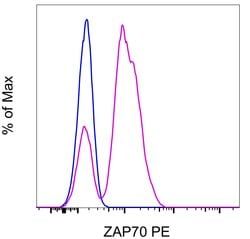
- Specificity of this SC1T2M3 clone was determined by ELISA, flow cytometry, and western blotting
- SRC is a cytoplasmic tyrosine kinase and proto-oncogene involved in the regulation of embryonic development and cell growth
- SRC is involved in the regulation of growth and differentiation of eukaryotic cells
- SRC associates with the cytoplasmic region of various cell surface receptors to facilitate signal transduction, and is also involved in cytoskeletal organization, cell cycle regulation, and apoptosis
- In humans, the gene encoding SRC is present on chromosome 20
- Activity of SRC is regulated by two tyrosine residues (Tyr 416 and Tyr527), and phosphorylation of these two sites have opposing effects
- Phosphorylation of Tyr416 in the activation loop of the kinase domain upregulates enzyme activity while the phosphorylation of Tyr527 decreases enzyme activity
- Mutations in the SRC gene could be involved in the malignant progression of colon cancer
- Two transcript variants encoding the same SRC protein have been found thus far.