CD3 Monoclonal Antibody (SK7), Brilliant Ultra Violet™ 496, eBioscience™, Invitrogen™
Mouse Monoclonal Antibody
Manufacturer: Fischer Scientific
The price for this product is unavailable. Please request a quote
Antigen
CD3
Concentration
5 μL/Test
Classification
Monoclonal
Form
Liquid
Regulatory Status
RUO
Formulation
PBS with BSA and 0.09% sodium azide; pH 7.2
Gene Alias
4930549J05Rik; A430104F18Rik; AI504783; antigen CD3D, delta polypeptide (TiT3 complex); antigen CD3E, epsilon polypeptide (TiT3 complex); antigen CD3G, gamma polypeptide; antigen CD3Z, zeta polypeptide; AW552088; Cd247; CD247 antigen; CD247 antigen, zeta subunit; Cd247 molecule; CD3; CD3 antigen delta chain; CD3 antigen delta polypeptide; CD3 antigen gamma chain; CD3 antigen, delta polypeptide; CD3 antigen, delta subunit; CD3 antigen, epsilon polypeptide; CD3 antigen, gamma polypeptide; CD3 antigen, zeta polypeptide; CD3 delta; CD3 epsilon; CD3 epsilon chain; CD3 epsilon subunit; CD3 epsilon subunit precursor; CD3 gamma-chain; CD3 glycoprotein; CD3 glycoprotein precursor; CD3 molecule delta polypeptide; CD3 molecule, delta; CD3 molecule, epsilon; CD3 molecule, epsilon polypeptide; CD3 molecule, gamma; CD3 molecule, gamma polypeptide; CD3 protein; CD3 TCR complex; CD3 type I transmembrane glycoprotein; CD3 type I transmembrane glycoprotein precursor; CD3 zeta chain; Cd3d; CD3D antigen d
Gene Symbols
Cd247, Cd3d, CD3E, CD3g
Primary or Secondary
Primary
Content And Storage
4° C, store in dark, DO NOT FREEZE!
Clone
SK7
Applications
Flow Cytometry
Conjugate
Brilliant Ultraviolet 496
Host Species
Mouse
Target Species
Chimpanzee, Human
Gene Accession No.
P04234, P07766, P09693, P20963
Gene ID (Entrez)
451584, 451585, 742330, 748272, 915, 916, 917, 919
Isotype
IgG1 κ
Purification Method
Affinity chromatography
Product Type
Antibody
Related Products
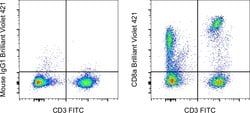
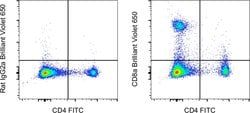

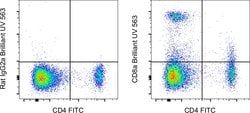
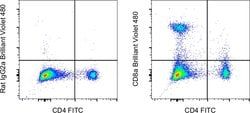
Description
- The SK7 mAb reacts with human and chimpanzee CD3e, a 20 kDa subunit of the TCR complex
- Along with the other CD3 subunits gamma and delta, the epsilon chain is required for proper assembly, trafficking and surface expression of the TCR complex
- CD3 is expressed by thymocytes in a developmentally regulated manner and by all mature T cells
- The SK7 and UCHT1 monoclonal antibodies cross-block binding, suggesting recognition of overlapping epitope
- In contrast clones OKT3 and SK7 see different epitopes
- The antibody SK7 recognizes chimpanzee CD3
- Applications Reported: This SK7 antibody has been reported for use in flow cytometric analysis
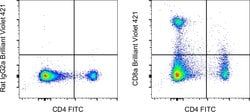
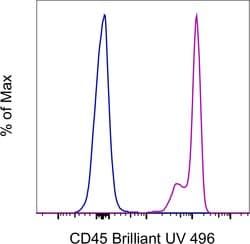
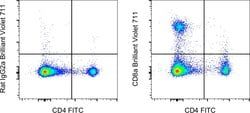
- Applications Tested: This SK7 antibody has been pre-diluted and tested by flow cytometric analysis of normal human peripheral blood cells
- This may be used at 5uL (1ug) per test BUV496 is a tandem dye that emits at 496 nm and is intended for use on cytometers equipped with an Ultraviolet (355 nm) laser
- Please make sure that your instrument is capable of detecting this fluorochrome
- When using two or more Super Bright, BV, BUV, or other polymer dye-conjugated antibodies in a staining panel, it is recommended to use Super Bright Complete Staining Buffer (SB-4401-42) or Brilliant Stain Buffer (00-4409-75) to minimize any non-specific polymer interactions
- Light sensitivity: This tandem dye is sensitive to photo-induced oxidation
- Excitation: 350 nm; Emission: 496 nm; Laser: Ultraviolet Laser
- The CD3 subunit complex which is crucial in transducing antigen-recognition signals into the cytoplasm of T cells and in regulating the cell surface expression of the TCR complex
- T cell activation through the antigen receptor (TCR) involves the cytoplasmic tails of the CD3 subunits CD3 gamma, CD3 delta, CD3 epsilon and CD3 zeta
- These CD3 subunits are structurally related members of the immunoglobulins super family encoded by closely linked genes on human chromosome 11
- The CD3 components have long cytoplasmic tails that associate with cytoplasmic signal transduction molecules and this association is mediated at least in part by a double tyrosine-based motif present in a single copy in the CD3 subunits
- CD3 may play a role in TCR-induced growth arrest, cell survival and proliferation
- The CD3 antigen is present on 68-82% of normal peripheral blood lymphocytes, 65-85% of thymocytes and Purkinje cells in the cerebellum
- It is never expressed on B or NK cells
- Decreased percentages of T lymphocytes may be observed in some autoimmune diseases
- The genes encoding the CD3 epsilon, gamma and delta polypeptides are located on chromosome 11
- Defects in the CD3 gene are associated with CD3 immunodeficiency.