CD14 Monoclonal Antibody (61D3), Brilliant Violet™ 421, eBioscience™, Invitrogen™
Mouse Monoclonal Antibody
Manufacturer: Fischer Scientific
The price for this product is unavailable. Please request a quote
Antigen
CD14
Concentration
5 μL/Test
Classification
Monoclonal
Form
Liquid
Regulatory Status
RUO
Formulation
PBS with BSA and 0.09% sodium azide; pH 7.2
Gene Alias
CD 14; CD14; CD14 antigen; CD14 molecule; cd14 monocyte; lipopolysaccharide receptor; lipoprotein receptor; LPSR antibody; monocyte differentiation antigen CD14; Monocyte differentiation antigen CD14, membrane-bound form; Monocyte differentiation antigen CD14, urinary form; monocyte differentiation antigen CD14; LOW QUALITY PROTEIN: monocyte differentiation antigen CD14; myeloid cell-specific leucine-rich glycoprotein; myeloid membrane glycoprotein precursor; sCD14; soluble CD14
Gene Symbols
Cd14
Primary or Secondary
Primary
Content And Storage
4° C, store in dark, DO NOT FREEZE!
Gene
Cd14
Clone
61D3
Applications
Flow Cytometry
Conjugate
Brilliant Violet 421
Host Species
Mouse
Target Species
Human
Gene Accession No.
P08571
Gene ID (Entrez)
929
Isotype
IgG1 κ
Purification Method
Affinity chromatography
Product Type
Antibody
Related Products




Description
- The 61D3 monoclonal antibody reacts with human CD14, a 53-55 kDa GPI-linked glycoprotein
- CD14 is expressed on monocytes, interfollicular macrophages and some dendritic cells
- Complexes of LPS and LBP (LPS-Binding Protein) bind with high affinity to monocytes through the surface CD14
- Applications Reported: This 61D3 antibody has been reported for use in flow cytometric analysis
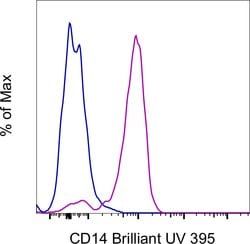
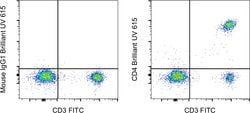
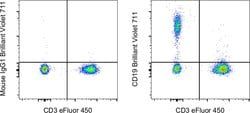
- Applications Tested: This 61D3 antibody has been pre-diluted and tested by flow cytometric analysis of normal human peripheral blood cells
- This may be used at 5 μL (0.5 μg) per test Brilliant Violet 421 (BV421) is a dye that emits at 423 nm and is intended for use on cytometers equipped with a violet (405 nm) laser
- Please make sure that your instrument is capable of detecting this fluorochrome
- When using two or more Super Bright, Brilliant Violet, Brilliant Ultra Violet, or other polymer dye-conjugated antibodies in a staining panel, it is recommended to use Super Bright Complete Staining Buffer (Product # SB-4401-42) or Brilliant Stain Buffer™ (Product # 00-4409-75) to minimize any non-specific polymer interactions
- Please refer to the datasheet for Super Bright Staining Buffer or Brilliant Stain Buffer for more information
- Excitation: 407 nm; Emission: 423 nm; Laser: Violet Laser
- BRILLIANT Violet is a trademark or registered trademark of Becton, Dickinson and Company or its affiliates, and is used under license
- Powered by Sirigen.™ CD14 is a 55 kDa GPI-anchored glycoprotein that is constitutively expressed on the surface of mature monocytes, macrophages, and neutrophils
- CD14 also serves as a multifunctional lipopolysaccharide receptor, and is released to the serum both as a secreted and enzymatically cleaved GPI-anchored form
- CD14 binds lipopolysaccharide molecule in a reaction catalyzed by lipopolysaccharide-binding protein (LBP), an acute phase serum protein
- The soluble sCD14 can discriminate slight structural differences between lipopolysaccharides and is important for neutralization of serum allochthonous lipopolysaccharides by reconstituted lipoprotein particles
- Further, CD14 has been shown to bind apoptotic cells, and can affect allergic, inflammatory and infectious processes
- Alternative splicing results in multiple transcript variants encoding the same CD14 isoform
- Diseases associated with CD14 dysfunction include mycobacterium chelonae infection and Croup.