89-001-347
DEAD (Asp-Glu-Ala-Asp) box polypeptide 54, Mouse, Clone: 2E4, Abnova™
Manufacturer: Abnova Corporation
Select a Size
| Pack Size | SKU | Availability | Price |
|---|---|---|---|
| Each of 1 | 89-001-347-Each-of-1 | In Stock | ₹ 45,657.00 |
89-001-347 - Each of 1
In Stock
Quantity
1
Base Price: ₹ 45,657.00
GST (18%): ₹ 8,218.26
Total Price: ₹ 53,875.26
Antigen
DEAD (Asp-Glu-Ala-Asp) box polypeptide 54
Classification
Monoclonal
Conjugate
Unconjugated
Formulation
PBS with no preservative; pH 7.4
Gene Accession No.
NM_024072
Gene Symbols
DDX54
Immunogen
DDX54 (NP_076977, 778 a.a. ∼ 881 a.a) partial recombinant protein with GST tag. MW of the GST tag alone is 26 KDa.
Quantity
50 μg
Research Discipline
Signal Transduction
Primary or Secondary
Primary
Target Species
Human
Product Type
Antibody
Applications
ELISA, Immunohistochemistry (PFA fixed), Western Blot
Clone
2E4
Description
Mouse monoclonal antibody raised against a partial recombinant DDX54.
Gene
DDX54
Gene Alias
DP97/MGC2835
Host Species
Mouse
Purification Method
Affinity Purified
Regulatory Status
RUO
Whole Molecule
Yes
Gene ID (Entrez)
79039
Content And Storage
Store at -20°C or lower. Aliquot to avoid repeated freezing and thawing.
Isotype
IgG1 κ
Related Products
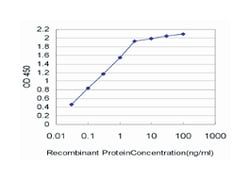
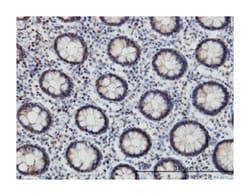
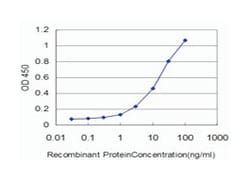
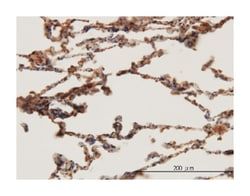
Description
- This gene encodes a member of the DEAD box protein family
- DEAD box proteins, characterized by the conserved motif Asp-Glu-Ala-Asp (DEAD), are putative RNA helicases
- They are implicated in a number of cellular processes involving alteration of RNA secondary structure such as translation initiation, nuclear and mitochondrial splicing, and ribosome and spliceosome assembly
- Based on their distribution patterns, some members of this family are believed to be involved in embryogenesis, spermatogenesis, and cellular growth and division
- The nucleolar protein encoded by this gene interacts in a hormone-dependent manner with nuclear receptors, and represses their transcriptional activity
- Alternative splice variants that encode different isoforms have been found for this gene
- [provided by RefSeq Sequence: DDRDSDEEGASDRRGPERRGGKRDRGQGASRPHAPGTPAGRVRPELKTKQQILKQRRRAQKLHFLQRGGLKQLSARNRRRVQELQQGAFGRGARSKKGKMRKRM