DUX4, Mouse, FITC, Clone: P2B1, Abnova™
Manufacturer: Abnova Corporation
Select a Size
| Pack Size | SKU | Availability | Price |
|---|---|---|---|
| Each of 1 | 89-109-604-Each-of-1 | In Stock | ₹ 1,22,553.00 |
89-109-604 - Each of 1
In Stock
Quantity
1
Base Price: ₹ 1,22,553.00
GST (18%): ₹ 22,059.54
Total Price: ₹ 1,44,612.54
Antigen
DUX4
Classification
Monoclonal
Conjugate
FITC
Dilution
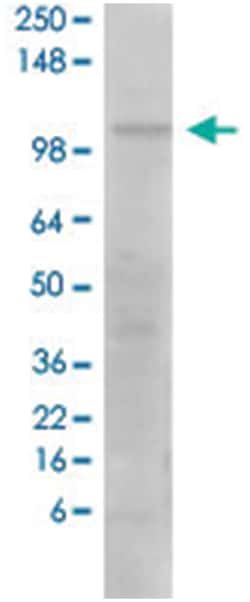
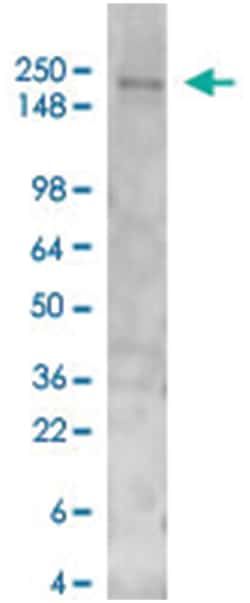
Western Blot (1:1000) The optimal working dilution should be determined by the end user.
Gene
DUX4
Gene Symbols
DUX4
Immunogen
Recombinant GST fusion protein corresponding to a 76 amino acid fragment at C-terminus of human DUX4.
Quantity
100 μg
Primary or Secondary
Primary
Test Specificity
This antibody recognizes human DUX4. It does not cross-react with DUX4c.
Content And Storage
Store at 4°C.Aliquot to avoid repeated freezing and thawing.
Isotype
IgG1
Applications
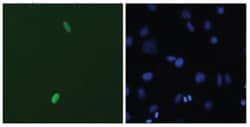
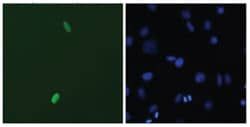
Immunofluorescence, Immunohistochemistry, Western Blot
Clone
P2B1
Description
Mouse monoclonal antibody raised against recombinant partial DUX4.
Formulation
In PBS, pH 7.4 (50% glycerol, 0.09% sodium azide)
Gene Alias
DUX10
Host Species
Mouse
Purification Method
Protein G purification
Regulatory Status
RUO
Gene ID (Entrez)
22947
Target Species
Human
Form
Liquid
Related Products

Description
- This gene is located within a D4Z4 repeat array in the subtelomeric region of chromosome 4q
- The D4Z4 repeat is polymorphic in length; a similar D4Z4 repeat array has been identified on chromosome 10
- Each D4Z4 repeat unit has an open reading frame (named DUX4) that contains two homeoboxes; the repeat-array and ORF is conserved in other mammals
- There was no evidence for transcription from standard cDNA libraries however RTPCR and in-vitro expression experiments indicate that the ORF is transcribed and the encoded protein has been reported to function as a transcriptional activator of paired-like homeodomain transcription factor 1 (PITX1; GeneID 5307)
- Contraction of the microsatellite repeat causes autosomal dominant facioscapulohumeral muscular dystrophy (FSHD)
- [provided by RefSeq