89-110-685
ESR1, Mouse, Clone: TE111.5D11, Abnova™
Manufacturer: Abnova Corporation
Select a Size
| Pack Size | SKU | Availability | Price |
|---|---|---|---|
| Each of 1 | 89-110-685-Each-of-1 | In Stock | ₹ 1,39,018.00 |
89-110-685 - Each of 1
In Stock
Quantity
1
Base Price: ₹ 1,39,018.00
GST (18%): ₹ 25,023.24
Total Price: ₹ 1,64,041.24
Antigen
ESR1
Classification
Monoclonal
Conjugate
Unconjugated
Dilution
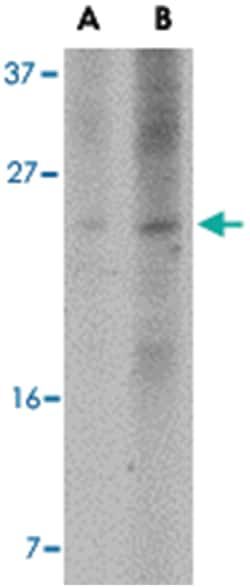
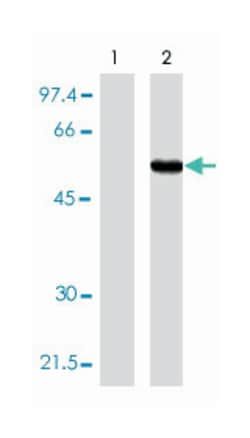
Western Blot (1-2 ug/mL) Immunoprecipitation (2 ug/mg) The optimal working dilution should be determined by the end user.
Gene
ESR1
Gene Symbols
ESR1
Immunogen
Recombinant protein corresponding to amino acids 302-595 of human ESR1.
Regulatory Status
RUO
Gene ID (Entrez)
2099
Form
Liquid
Applications
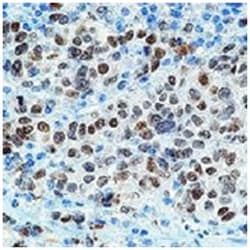
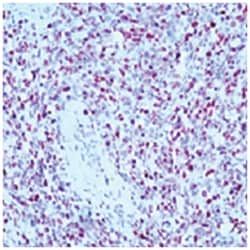
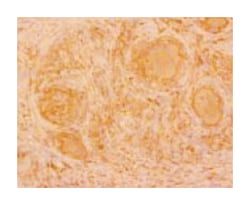
Immunoprecipitation, Western Blot
Clone
TE111.5D11
Description
Mouse monoclonal antibody raised against partial recombinant ESR1.
Formulation
In PBS (0.08% sodium azide)
Gene Alias
DKFZp686N23123/ER/ESR/ESRA/Era/NR3A1
Host Species
Mouse
Quantity
100 μg
Primary or Secondary
Primary
Content And Storage
Store at -20°C.Aliquot to avoid repeated freezing and thawing.
Isotype
IgG1
Related Products

Description
- This gene encodes an estrogen receptor, a ligand-activated transcription factor composed of several domains important for hormone binding, DNA binding, and activation of transcription
- The protein localizes to the nucleus where it may form a homodimer or a heterodimer with estrogen receptor 2
- Estrogen and its receptors are essential for sexual development and reproductive function, but also play a role in other tissues such as bone
- Estrogen receptors are also involved in pathological processes including breast cancer, endometrial cancer, and osteoporosis
- Alternative splicing results in several transcript variants, which differ in their 5' UTRs and use different promoters
- [provided by RefSeq]