89-115-207
TMPRSS2, Goat, Polyclonal Antibody, Abnova™
Manufacturer: Abnova Corporation
Select a Size
| Pack Size | SKU | Availability | Price |
|---|---|---|---|
| Each of 1 | 89-115-207-Each-of-1 | In Stock | ₹ 71,022.00 |
89-115-207 - Each of 1
In Stock
Quantity
1
Base Price: ₹ 71,022.00
GST (18%): ₹ 12,783.96
Total Price: ₹ 83,805.96
Antigen
TMPRSS2
Classification
Polyclonal
Conjugate
Unconjugated
Dilution
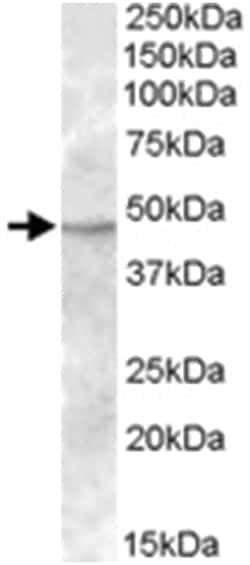
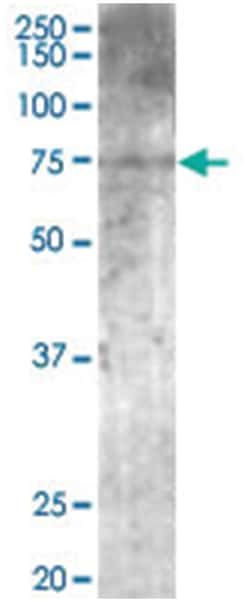
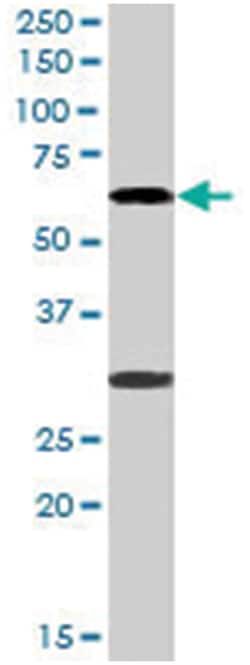
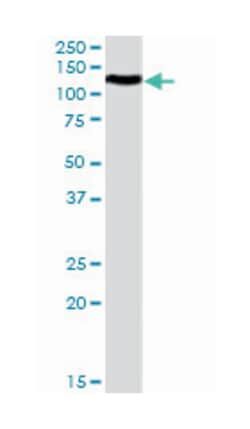
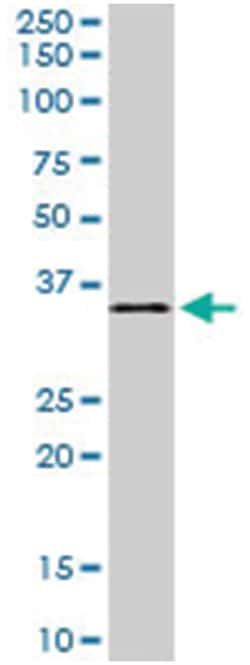
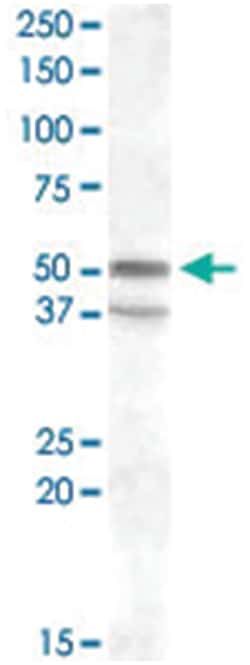
ELISA (1:8000) Western Blot (0.1-0.3 ug/mL) The optimal working dilution should be determined by the end user.
Gene
TMPRSS2
Gene Symbols
TMPRSS2
Immunogen
A synthetic peptide corresponding to human TMPRSS2.
Quantity
100 μg
Primary or Secondary
Primary
Target Species
Human
Form
Liquid
Applications
ELISA, Western Blot
Concentration
0.5 mg/mL
Description
Goat polyclonal antibody raised against synthetic peptide of TMPRSS2.
Formulation
In Tris saline, pH 7.3 (0.5% BSA, 0.02% sodium azide)
Gene Alias
FLJ41954/PP9284/PRSS10
Host Species
Goat
Purification Method
Antigen affinity purification
Regulatory Status
RUO
Gene ID (Entrez)
7113
Content And Storage
Store at -20°C.Aliquot to avoid repeated freezing and thawing.
Related Products


Description
- This gene encodes a protein that belongs to the serine protease family
- The encoded protein contains a type II transmembrane domain, a receptor class A domain, a scavenger receptor cysteine-rich domain and a protease domain
- Serine proteases are known to be involved in many physiological and pathological processes
- This gene was demonstrated to be up-regulated by androgenic hormones in prostate cancer cells and down-regulated in androgen-independent prostate cancer tissue
- The protease domain of this protein is thought to be cleaved and secreted into cell media after autocleavage
- Alternatively spliced transcript variants encoding different isoforms have been found for this gene
- [provided by RefSeq Sequence: C-TDWIYRQMRADG