89-115-850
BAI1 Rabbit anti-Human, Mouse, Polyclonal Antibody, Abnova™
Manufacturer: Abnova Corporation
Select a Size
| Pack Size | SKU | Availability | Price |
|---|---|---|---|
| Each of 1 | 89-115-850-Each-of-1 | In Stock | ₹ 87,042.00 |
89-115-850 - Each of 1
In Stock
Quantity
1
Base Price: ₹ 87,042.00
GST (18%): ₹ 15,667.56
Total Price: ₹ 1,02,709.56
Antigen
BAI1
Classification
Polyclonal
Description
Rabbit polyclonal antibody raised against synthetic peptide of BAI1.
Formulation
In Tris-citrate/phosphate buffer, pH 7.0-8.0 (0.09% sodium azide)
Gene Accession No.
O14514
Gene Symbols
BAI1
Immunogen
A synthetic peptide corresponding to amino acids 1500-1684 of human BAI1.
Regulatory Status
RUO
Gene ID (Entrez)
575
Content And Storage
Store at 4°C. Do not freeze.
Applications
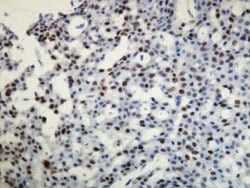
Immunohistochemistry (PFA fixed)
Conjugate
Unconjugated
Dilution
Immunohistochemistry (Formalin/PFA-fixed paraffin-embedded sections) (1:4000) The optimal working dilution should be determined by the end user.
Gene
BAI1
Gene Alias
FLJ41988
Host Species
Rabbit
Quantity
100 μL
Primary or Secondary
Primary
Target Species
Human, Mouse
Form
Liquid
Related Products
Description
- Angiogenesis is controlled by a local balance between stimulators and inhibitors of new vessel growth and is suppressed under normal physiologic conditions
- Angiogenesis has been shown to be essential for growth and metastasis of solid tumors
- In order to obtain blood supply for their growth, tumor cells are potently angiogenic and attract new vessels as results of increased secretion of inducers and decreased production of endogenous negative regulators
- BAI1 contains at least one 'functional' p53-binding site within an intron, and its expression has been shown to be induced by wildtype p53
- There are two other brain-specific angiogenesis inhibitor genes, designated BAI2 and BAI3 which along with BAI1 have similar tissue specificities and structures, however only BAI1 is transcriptionally regulated by p53
- BAI1 is postulated to be a member of the secretin receptor family, an inhibitor of angiogenesis and a growth suppressor of glioblastomas [provided by RefSeq]