89-119-278
ATP5G2, Rabbit, Polyclonal Antibody, Abnova™
Manufacturer: Abnova Corporation
Select a Size
| Pack Size | SKU | Availability | Price |
|---|---|---|---|
| Each of 1 | 89-119-278-Each-of-1 | In Stock | ₹ 55,892.00 |
89-119-278 - Each of 1
In Stock
Quantity
1
Base Price: ₹ 55,892.00
GST (18%): ₹ 10,060.56
Total Price: ₹ 65,952.56
Antigen
ATP5G2
Classification
Polyclonal
Description
Rabbit polyclonal antibody raised against synthetic peptide of ATP5G2.
Formulation
In PBS, pH 7.4 (150mM NaCl, 0.02% sodium azide, 50% glycerol)
Gene Accession No.
Q06055
Host Species
Rabbit
Quantity
100 μg
Primary or Secondary
Primary
Test Specificity
This antibody detects endogenous levels of total ATP5G2 protein.
Content And Storage
Store at -20°C.Aliquot to avoid repeated freezing and thawing.
Applications
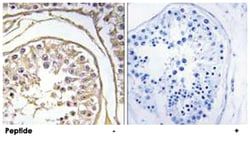
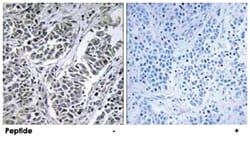
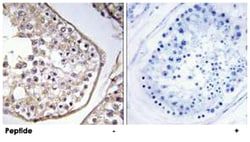
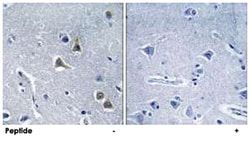
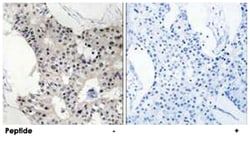
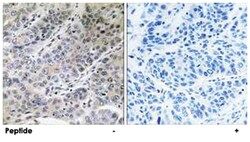
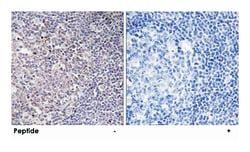
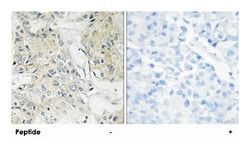
ELISA, Immunohistochemistry (PFA fixed)
Conjugate
Unconjugated
Dilution
Immunohistochemistry (1:50-1:100) ELISA (1:40000) The optimal working dilution should be determined by the end user.
Gene
ATP5G2
Gene Symbols
ATP5G2
Immunogen
A synthetic peptide corresponding to amino acids 1-50 of human ATP5G2.
Regulatory Status
RUO
Gene ID (Entrez)
517
Target Species
Human
Form
Liquid
Related Products
Description
- This gene encodes a subunit of mitochondrial ATP synthase
- Mitochondrial ATP synthase catalyzes ATP synthesis, utilizing an electrochemical gradient of protons across the inner membrane during oxidative phosphorylation
- ATP synthase is composed of two linked multi-subunit complexes: the soluble catalytic core, F1, and the membrane-spanning component, F0, comprising the proton channel
- The catalytic portion of mitochondrial ATP synthase consists of 5 different subunits (alpha, beta, gamma, delta, and epsilon) assembled with a stoichiometry of 3 alpha, 3 beta, and single representatives of the gamma, delta, and epsilon subunits
- The proton channel likely has nine subunits (a, b, c, d, e, f, g, F6 and 8)
- There are three separate genes which encode subunit c of the proton channel and they specify precursors with different import sequences but identical mature proteins
- The protein encoded by this gene is one of three precursors of subunit c
- Alternatively spliced transcript variants encoding different isoforms have been identified
- This gene has multiple pseudogenes
- [provided by RefSeq