PKN1 Mouse anti-Human, Clone:4H10B1, Abnova™
Manufacturer: Abnova Corporation
Select a Size
| Pack Size | SKU | Availability | Price |
|---|---|---|---|
| Each of 1 | 89-333-130-Each-of-1 | In Stock | ₹ 60,787.00 |
89-333-130 - Each of 1
In Stock
Quantity
1
Base Price: ₹ 60,787.00
GST (18%): ₹ 10,941.66
Total Price: ₹ 71,728.66
Antigen
PKN1
Classification
Monoclonal
Conjugate
Unconjugated
Dilution
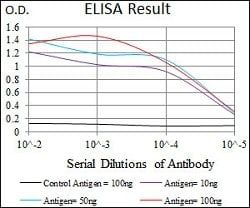
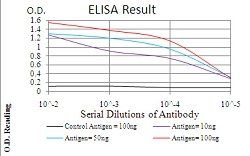
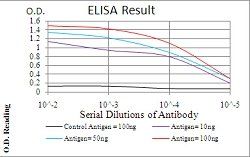
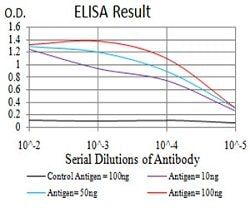
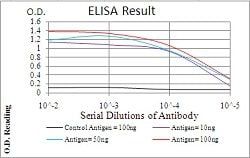
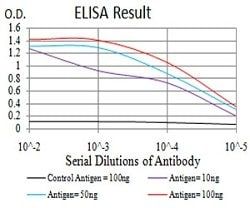
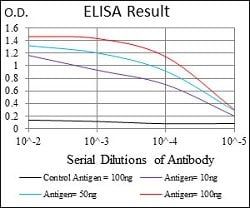
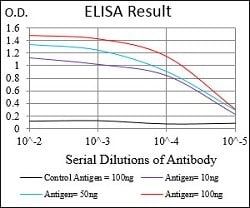
ELISA (1:10000)Western Blot (1:500-1:2000)Immunohistochemistry (1:200-1:1000)Immunocytochemistry (1:200-1:1000)Flow Cytometry (1:200-1:400)The optimal working dilution should be determined by the end user.
Gene
PKN1
Host Species
Mouse
Quantity
100 μg
Target Species
Human
Product Type
Antibody
Isotype
IgG2b
Applications
ELISA, Flow Cytometry, Immunocytochemistry, Immunohistochemistry (Paraffin), Western Blot
Clone
4H10B1
Description
protein kinase N1
Formulation
In PBS (0.05% sodium azide)
Gene Alias
DBK, MGC46204, PAK1, PKN, PKN-ALPHA, PRK1, PRKCL1
Immunogen
Recombinant protein corresponding to amino acid 442-620 of human PKN1 fromE. coli.
Gene ID (Entrez)
5585
Content And Storage
Store at 4°C. For long term storage store at -20°C.Aliquot to avoid repeated freezing and thawing.
Form
Liquid
Related Products
Description
- The protein encoded by this gene belongs to the protein kinase C superfamily
- This kinase is activated by Rho family of small G proteins and may mediate the Rho-dependent signaling pathway
- This kinase can be activated by phospholipids and by limited proteolysis
- The 3-phosphoinositide dependent protein kinase-1 (PDPK1/PDK1) is reported to phosphorylate this kinase, which may mediate insulin signals to the actin cytoskeleton
- The proteolytic activation of this kinase by caspase-3 or related proteases during apoptosis suggests its role in signal transduction related to apoptosis
- Alternatively spliced transcript variants encoding distinct isoforms have been observed
- [provided by RefSeq]