89-333-134
PTPN1 Mouse anti-Human, Clone:4F11B9, Abnova™
Manufacturer: Abnova Corporation
Select a Size
| Pack Size | SKU | Availability | Price |
|---|---|---|---|
| Each of 1 | 89-333-134-Each-of-1 | In Stock | ₹ 60,787.00 |
89-333-134 - Each of 1
In Stock
Quantity
1
Base Price: ₹ 60,787.00
GST (18%): ₹ 10,941.66
Total Price: ₹ 71,728.66
Antigen
PTPN1
Classification
Monoclonal
Conjugate
Unconjugated
Dilution
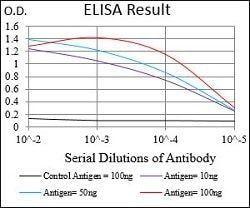
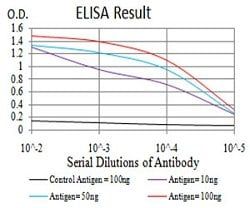
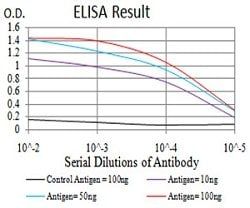
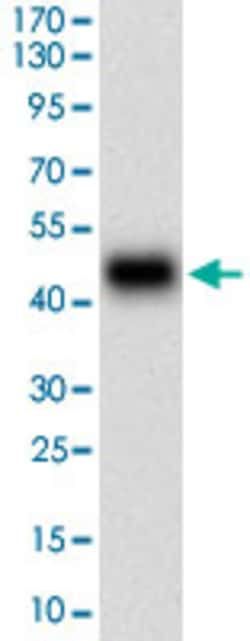
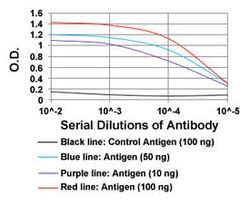
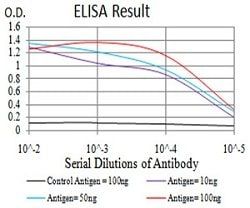
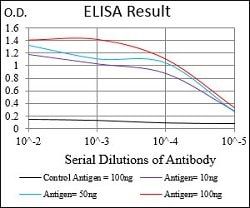
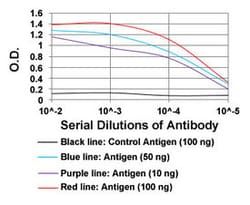
ELISA (1:10000)Western Blot (1:500-1:2000)Flow Cytometry (1:200-1:400)The optimal working dilution should be determined by the end user.
Gene
PTPN1
Host Species
Mouse
Quantity
100 μg
Target Species
Human
Product Type
Antibody
Isotype
IgG1
Applications
ELISA, Flow Cytometry, Western Blot
Clone
4F11B9
Description
protein tyrosine phosphatase, non-receptor type 1
Formulation
In PBS (0.05% sodium azide)
Gene Alias
PTP1B
Immunogen
Recombinant protein corresponding to amino acid 40-246 of human PTPN1 fromE. coli.
Gene ID (Entrez)
5770
Content And Storage
Store at 4°C. For long term storage store at -20°C.Aliquot to avoid repeated freezing and thawing.
Form
Liquid
Related Products
Description
- The protein encoded by this gene is the founding member of the protein tyrosine phosphatase (PTP) family, which was isolated and identified based on its enzymatic activity and amino acid sequence
- PTPs catalyze the hydrolysis of the phosphate monoesters specifically on tyrosine residues
- Members of the PTP family share a highly conserved catalytic motif, which is essential for the catalytic activity
- PTPs are known to be signaling molecules that regulate a variety of cellular processes including cell growth, differentiation, mitotic cycle, and oncogenic transformation
- This PTP has been shown to act as a negative regulator of insulin signaling by dephosphorylating the phosphotryosine residues of insulin receptor kinase
- This PTP was also reported to dephosphorylate epidermal growth factor receptor kinase, as well as JAK2 and TYK2 kinases, which implicated the role of this PTP in cell growth control, and cell response to interferon stimulation
- [provided by RefSeq]