89-333-178
CSF1R Mouse anti-Human, Clone:4C9G2, Abnova™
Manufacturer: Abnova Corporation
Select a Size
| Pack Size | SKU | Availability | Price |
|---|---|---|---|
| Each of 1 | 89-333-178-Each-of-1 | In Stock | ₹ 60,787.00 |
89-333-178 - Each of 1
In Stock
Quantity
1
Base Price: ₹ 60,787.00
GST (18%): ₹ 10,941.66
Total Price: ₹ 71,728.66
Antigen
CSF1R
Classification
Monoclonal
Conjugate
Unconjugated
Dilution
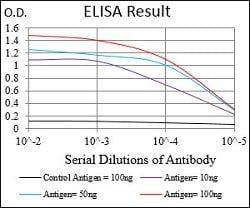
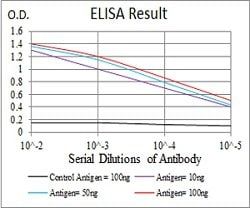
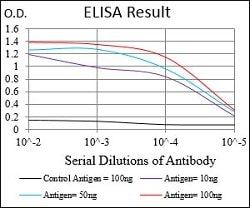
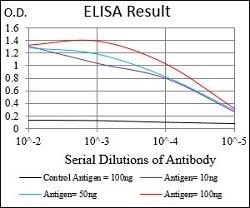
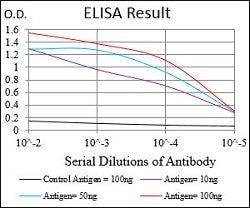
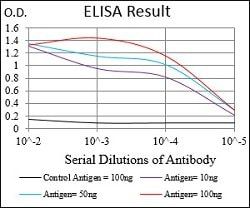
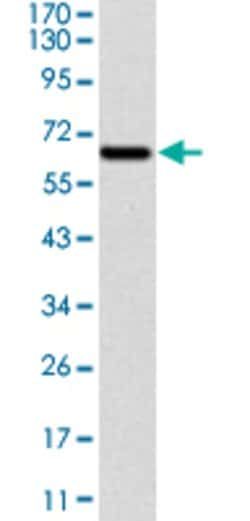
ELISA (1:10000)Western Blot (1:500-1:2000)ImmunohistochemistryImmunocytochemistryFlow Cytometry (1:200-1:400)The optimal working dilution should be determined by the end user.
Gene
CSF1R
Host Species
Mouse
Quantity
100 μg
Target Species
Human
Product Type
Antibody
Isotype
IgG1
Applications
ELISA, Flow Cytometry, Western Blot
Clone
4C9G2
Description
colony stimulating factor 1 receptor
Formulation
In PBS (0.05% sodium azide)
Gene Alias
C-FMS, CD115, CSFR, FIM2, FMS
Immunogen
Recombinant protein corresponding to amino acid 20-152 of human CSF1R fromE. coli.
Gene ID (Entrez)
1436
Content And Storage
Store at 4°C. For long term storage store at -20°C.Aliquot to avoid repeated freezing and thawing.
Form
Liquid
Related Products

Description
- The protein encoded by this gene is the receptor for colony stimulating factor 1, a cytokine which controls the production, differentiation, and function of macrophages
- This receptor mediates most if not all of the biological effects of this cytokine
- Ligand binding activates the receptor kinase through a process of oligomerization and transphosphorylation
- The encoded protein is a tyrosine kinase transmembrane receptor and member of the CSF1/PDGF receptor family of tyrosine-protein kinases
- Mutations in this gene have been associated with a predisposition to myeloid malignancy
- The first intron of this gene contains a transcriptionally inactive ribosomal protein L7 processed pseudogene oriented in the opposite direction
- [provided by RefSeq]