CDH16 Mouse anti-Human, Clone: SPM594, Abnova™
Manufacturer: Abnova Corporation
Select a Size
| Pack Size | SKU | Availability | Price |
|---|---|---|---|
| Each of 1 | 89-933-916-Each-of-1 | In Stock | ₹ 67,017.00 |
89-933-916 - Each of 1
In Stock
Quantity
1
Base Price: ₹ 67,017.00
GST (18%): ₹ 12,063.06
Total Price: ₹ 79,080.06
Antigen
CDH16
Classification
Monoclonal
Conjugate
Unconjugated
Dilution
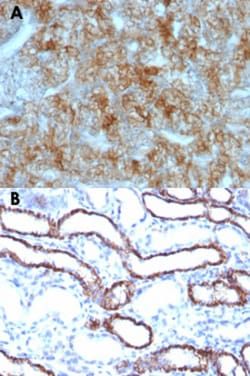
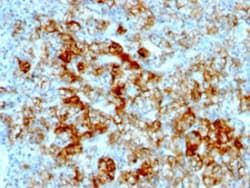
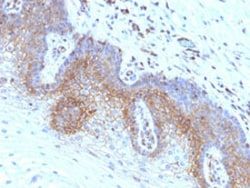
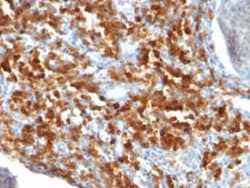
Flow Cytometry (0.5-1 ug/million cells in 0.1 mL) Immunofluorescence (1-2 ug/mL) Immunohistochemistry (Formalin/PFA-fixed paraffin-embedded sections) (0.5-1 ug/mL) The optimal working dilution should be determined by the end user.
Gene Symbols
CDH16
Immunogen
Recombinant protein corresponding to full length of human CDH16.
Quantity
100 μg
Primary or Secondary
Primary
Target Species
Human
Form
Liquid
Applications
Flow Cytometry, Immunofluorescence, Immunohistochemistry (PFA fixed)
Clone
SPM594
Description
Mouse monoclonal antibody raised against full length recombinant human CDH16.
Formulation
In 10mM PBS.
Host Species
Mouse
Purification Method
Protein A/G purification
Regulatory Status
RUO
Gene ID (Entrez)
1014
Content And Storage
Store at -20 to -80°C.Aliquot to avoid repeated freezing and thawing.
Isotype
IgG1 κ
Related Products

Description
- This gene is a member of the cadherin superfamily, genes encoding calcium-dependent, membrane-associated glycoproteins
- Mapped to a previously identified cluster of cadherin genes on chromosome 16q22.1, the gene localizes with superfamily members CDH1, CDH3, CDH5, CDH8 and CDH11
- The protein consists of an extracellular domain containing 6 cadherin domains, a transmembrane region and a truncated cytoplasmic domain but lacks the prosequence and tripeptide HAV adhesion recognition sequence typical of most classical cadherins
- Expression is exclusively in kidney, where the protein functions as the principal mediator of homotypic cellular recognition, playing a role in the morphogenic direction of tissue development
- [provided by RefSeq]