PAX6 Mouse anti-Human, Clone: SPM612, Abnova™
Manufacturer: Abnova Corporation
Select a Size
| Pack Size | SKU | Availability | Price |
|---|---|---|---|
| Each of 1 | 89-934-733-Each-of-1 | In Stock | ₹ 67,017.00 |
89-934-733 - Each of 1
In Stock
Quantity
1
Base Price: ₹ 67,017.00
GST (18%): ₹ 12,063.06
Total Price: ₹ 79,080.06
Antigen
PAX6
Classification
Monoclonal
Conjugate
Unconjugated
Dilution
Flow Cytometry (0.5-1 ug/106cells in 0.1 mL) Immunofluorescence (0.5-1 ug/mL) Immunohistochemistry (Formalin/PFA-fixed paraffin-embedded sections) (0.5-1 ug/mL) The optimal working dilution should be determined by the end user.
Gene Alias
AN/AN2/D11S812E/MGC17209/MGDA/WAGR
Host Species
Mouse
Purification Method
Protein A/G purification
Regulatory Status
RUO
Gene ID (Entrez)
5080
Content And Storage
Store at -20 to -80°C.Aliquot to avoid repeated freezing and thawing.
Isotype
IgG1 κ
Applications
Flow Cytometry, Immunofluorescence, Immunohistochemistry (PFA fixed)
Clone
SPM612
Description
Mouse monoclonal antibody raised against partial recombinant human PAX6.
Formulation
In 10mM PBS.
Gene Symbols
PAX6
Immunogen
Recombinant protein corresponding to amino acids 1-300 at N-terminus region of human PAX6.
Quantity
100 μg
Primary or Secondary
Primary
Target Species
Human
Form
Liquid
Related Products
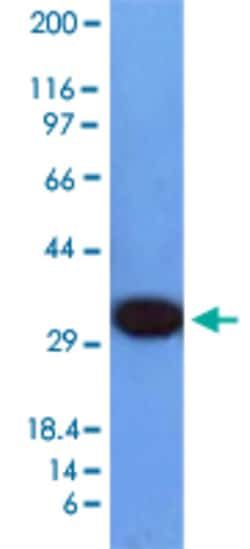
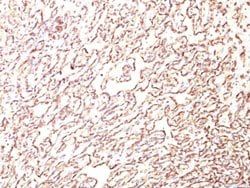
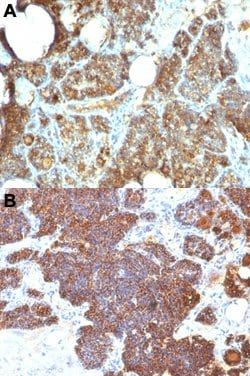
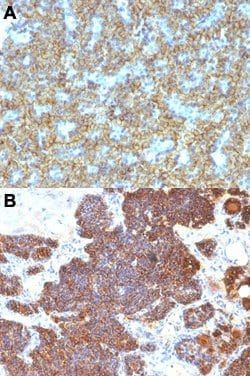
Description
- This gene encodes paired box gene 6, one of many human homologs of the Drosophila melanogaster gene prd
- In addition to the hallmark feature of this gene family, a conserved paired box domain, the encoded protein also contains a homeo box domain
- Both domains are known to bind DNA, and function as regulators of gene transcription
- This gene is expressed in the developing nervous system, and in developing eyes
- Mutations in this gene are known to cause ocular disorders such as aniridia and Peter's anomaly
- Alternatively spliced transcript variants encoding either the same or different isoform have been found for this gene
- [provided by RefSeq]