c-Myc Monoclonal Antibody (9E11), Invitrogen™
Manufacturer: Thermo Scientific
Select a Size
| Pack Size | SKU | Availability | Price |
|---|---|---|---|
| Each of 1 | AMPA6637-Each-of-1 | In Stock | ₹ 48,505.00 |
AMPA6637 - Each of 1
In Stock
Quantity
1
Base Price: ₹ 48,505.00
GST (18%): ₹ 8,730.90
Total Price: ₹ 57,235.90
Antigen
c-Myc
Classification
Monoclonal
Concentration
1 mg/mL
Formulation
PBS with 0.05% sodium azide
Gene Accession No.
P01106, P01108, P01109, P09416
Gene Symbols
MYC
Immunogen
Synthetic peptide, conjugated to KLH, corresponding to residues A(408) E E Q K L I S E E D L(420) of human c-Myc.
Quantity
100 μL
Primary or Secondary
Primary
Target Species
Chicken, Human, Mouse, Rat, Yeast
Product Type
Antibody
Isotype
IgG2a κ
Applications
ChIP Assay, ELISA, Flow Cytometry, Immunocytochemistry, Immunohistochemistry (Frozen), Immunohistochemistry (Paraffin), Immunoprecipitation, Western Blot
Clone
9E11
Conjugate
Unconjugated
Gene
MYC
Gene Alias
AU016757; Avian myelocytomatosis viral (v-myc) oncogene homolog; avian myelocytomatosis viral oncogene homolog; bHLHe39; c Myc; class E basic helix-loop-helix protein 39; cmyc; c-Myc; c-myc epitope tag; c-myc proto-oncogene; mMyc; MRTL; Myc; Myc protein; Myc proto-oncogene protein; MYC proto-oncogene, bHLH transcription factor; Myc2; MYCC; myc-related translation/localization regulatory factor; myelocytomatosis oncogene; myelocytomatosis viral oncogene homolog; Niard; Nird; Proto-oncogene c-Myc; RNCMYC; Transcription factor p64; v-myc avian myelocytomatosis viral oncogene homolog; v-myc myelocytomatosis viral oncogene homolog; v-myc myelocytomatosis viral oncogene-like protein
Host Species
Mouse
Purification Method
Protein A/G
Regulatory Status
RUO
Gene ID (Entrez)
17869, 24577, 420332, 4609
Content And Storage
Store at 4°C short term. For long term storage, store at -20°C, avoiding freeze/thaw cycles.
Form
Liquid
Related Products

Description
- Suggested positive control: antigen standard for MYC (transient overexpression lysate), HL-60 cells or breast tumors, HL-60 whole cell lysate, human breast carcinoma whole cell lysate
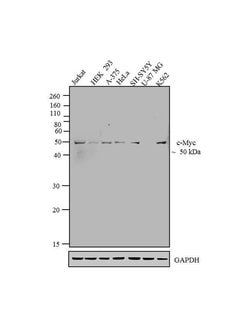
- The c-Myc protein is a 62 kDa transcription factor that is encoded by the c-Myc gene on human chromosome 8q24
- c-Myc is commonly activated in a variety of tumor cells and plays an important role in cellular proliferation, differentiation, apoptosis and cell cycle progression
- The phosphorylation of c-Myc has been investigated and previous studies have suggested a functional association between phosphorylation at Thr58/Ser62 by glycogen synthase kinase 3, cyclin dependent kinase, ERK2 and C-Jun N terminal Kinase (JNK) in cell proliferation and cell cycle regulation
- Studies have shown that c-Myc is essential for vasculogenesis and angiogenesis in tumor development, which distributes blood throughout the cells
- The c-myc oncogene (p62 c-myc) is involved in the control of normal cellular proliferation and differentiation, and the deregulated expression of c-Myc induces apoptosis in different cell types
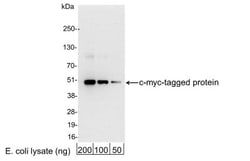
- Antibodies against c-myc epitopes recognize overexpressed proteins containing Myc epitope tag fused to either amino- or carboxy-termini of targeted proteins
- c-Myc-, N-Myc- and L-Myc-encoded proteins function in cell proliferation, differentiation and neoplastic disease
- Amplification of the c-Myc gene has been found in several types of human tumors including lung, breast and colon carcinomas, while the N-Myc gene has been found amplified in neuroblastomas
- Translocation of the c-myc locus on chromosome 8 to the immunoglobulin loci on chromosome 14 (heavy chain); 2 (delta light chain); or 22 (light chain) is described in Burkitts lymphoma and other B-cell lymphoproliferative conditions
- An aberrant expression of the c-myc gene occurs in tumors of different origins such as colorectal, gastric, gallbladder, hepatic, mammary, ovarian, endometrial, head and neck, pulmonary, prostatic, thyroidal, oral, ocular, nasopharyngeal, endocrine, as well as hematopoietic neoplasms.