Angiogenin Recombinant Rabbit Monoclonal Antibody (HL2214), Invitrogen™
Manufacturer: Thermo Scientific
Select a Size
| Pack Size | SKU | Availability | Price |
|---|---|---|---|
| Each of 1 | FEMA550435-Each-of-1 | In Stock | ₹ 41,385.00 |
FEMA550435 - Each of 1
In Stock
Quantity
1
Base Price: ₹ 41,385.00
GST (18%): ₹ 7,449.30
Total Price: ₹ 48,834.30
Antigen
Angiogenin
Classification
Recombinant Monoclonal
Concentration
1 mg/mL
Formulation
PBS with no preservative
Gene Accession No.
P03950, P21570
Gene Symbols
ANG
Immunogen
Recombinant fragment of human Angiogenin.
Quantity
100 μL
Primary or Secondary
Primary
Target Species
Human, Mouse
Form
Liquid
Applications
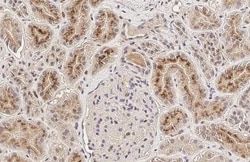
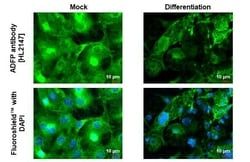
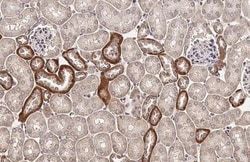
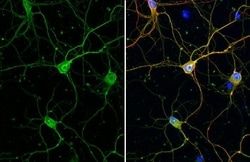
Immunocytochemistry, Immunohistochemistry (Paraffin), Western Blot
Clone
HL2214
Conjugate
Unconjugated
Gene
ANG
Gene Alias
AI385586, ALS9, ANG, Ang1, Angiogenin, angiogenin ribonuclease 1, angiogenin, ribonuclease A family, member 1, angiogenin, ribonuclease, RNase A family, 5, angiogenin-1, epididymis luminal protein 168, HEL168, MGC22466, MGC71966, RAA1, Ribonuclease 5, ribonuclease A A1, ribonuclease A family member 5, RNase 5, RNASE4, RNASE5, Rnase5a
Host Species
Rabbit
Purification Method
Protein A
Regulatory Status
RUO
Gene ID (Entrez)
11727, 283
Content And Storage
Store at 4°C short term. For long term storage, store at -20°C, avoiding freeze/thaw cycles.
Isotype
IgG
Related Products



Description
- Angiogenin (ANG or ANG I) is important for the process of neovascularization and formation of new blood vessels
- ANG is similar to pancreatic ribonuclease A and functions as a tRNA-specific ribonuclease that abolishes protein synthesis by specifically hydrolyzing cellular tRNAs
- It interacts with endothelial cell-surface actin and may cause changes in the cell cytoskeleton
- ANG is thought to be involved in the development of solid tumors and its antagonists are capable of inhibiting tumor growth
- Defects in ANG are the cause of susceptibility to amyotrophic lateral sclerosis type 9 (ALS9)
- Angiogenin is a genetic link between ALS and PD.