GSDMD Recombinant Rabbit Monoclonal Antibody (PD00-18), Invitrogen™
Manufacturer: Thermo Scientific
Select a Size
| Pack Size | SKU | Availability | Price |
|---|---|---|---|
| Each of 1 | FEMA550686-Each-of-1 | In Stock | ₹ 42,275.00 |
FEMA550686 - Each of 1
In Stock
Quantity
1
Base Price: ₹ 42,275.00
GST (18%): ₹ 7,609.50
Total Price: ₹ 49,884.50
Antigen
GSDMD
Classification
Recombinant Monoclonal
Concentration
1 mg/mL
Formulation
PBS with 0.1% BSA, 40% glycerol and 0.05% sodium azide; pH 7.4
Gene Accession No.
P57764, Q9D8T2
Gene Symbols
GSDMD
Immunogen
Recombinant protein within Gasdermin D full length protein aa 1-484/484.
Quantity
100 μL
Primary or Secondary
Primary
Target Species
Human, Mouse, Rat
Form
Liquid
Applications
Western Blot
Clone
PD00-18
Conjugate
Unconjugated
Gene
GSDMD
Gene Alias
1810036L03Rik, AW558049, DF5L, Dfna5l, FKSG10, gasdermin D, gasdermin domain containing 1, gasdermin domain-containing protein 1, Gasdermin-D, Gasdermin-D, C-terminal, Gasdermin-D, N-terminal, GSDMD, GSDMDC1, GSDMD-CT, GSDMD-NT, M2-4
Host Species
Rabbit
Purification Method
Protein A
Regulatory Status
RUO
Gene ID (Entrez)
315084, 69146, 79792
Content And Storage
Store at 4°C short term. For long term storage, store at -20°C, avoiding freeze/thaw cycles.
Isotype
IgG
Related Products



Description
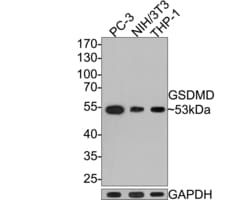
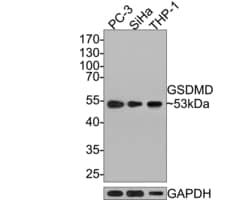
- Positive control: PC-3 cell lysate, NIH/3T3 cell lysate, THP-1 cell lysate, THP-1 cell lysate treated with PMA for 17.5 hours and then treated with LPS for 6 hours, PC-12 cell lysate, PMVEC cell lysate, RH-35 cell lysate, L6 cell lysate
- Predicted band size: 53/30 kDa Subcellular Location: Cell membrane, Secreted
- GSDMD (gasdermin-D) promotes pyroptosis in response to microbial infection and danger signals
- It is produced by the cleavage of gasdermin-D by inflammatory caspases CASP1 or CASP4 in response to canonical, as well as, non-canonical (such as cytosolic LPS) inflammasome activators
- After cleavage, GSDMD moves to the plasma membrane where it strongly binds to inner leaflet lipids including phosphatidylinositol 4-phosphate, phosphatidylinositol (4,5)-biphosphate, phosphatidylinositol (3,4,5)-biphosphate, phosphatidic acid, and phosphatidylserine
- GSDMD also exhibits bactericidal activity.