Phospho-PKC mu (Ser205) Polyclonal Antibody, Invitrogen™
Manufacturer: Thermo Scientific
Select a Size
| Pack Size | SKU | Availability | Price |
|---|---|---|---|
| Each of 1 | PA540259-Each-of-1 | In Stock | ₹ 46,057.50 |
PA540259 - Each of 1
In Stock
Quantity
1
Base Price: ₹ 46,057.50
GST (18%): ₹ 8,290.35
Total Price: ₹ 54,347.85
Antigen
Phospho-PKC mu (Ser205)
Classification
Polyclonal
Conjugate
Unconjugated
Gene
PRKD1
Gene Alias
4930557O20Rik; 5730497N19Rik; AI325941; DKFZP586E0820; EPK2; HSPC187; nPKC-D1; nPKC-D2; nPKC-mu; nPKC-nu; PKC mu; PKC nu; PKC u; PKC v; Pkcm; PKCmu; PKC-MU; Pkcnu; PKC-NU; PKCu; PKC-u; PKCv; PKC-v; Pkd; PKD1; PKD2; PKD3; Prkcm; PRKCN; Prkd1; PRKD2; PRKD3; Protein kinase C mu type; protein kinase C nu type; protein kinase C, mu; protein kinase C, nu; protein kinase D; protein kinase D1; protein kinase D2; protein kinase D3; protein kinase EPK2; RGD1308054; Serine/threonine-protein kinase D1; serine/threonine-protein kinase D2; Serine/threonine-protein kinase D3
Host Species
Rabbit
Purification Method
Antigen affinity chromatography
Regulatory Status
RUO
Gene ID (Entrez)
101540, 18760, 23683, 25865, 292658, 313834, 5587, 75292, 85421
Content And Storage
-20° C, Avoid Freeze/Thaw Cycles
Form
Liquid
Applications
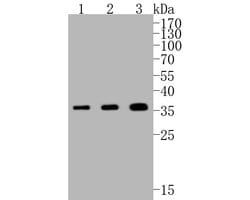
ELISA, Immunohistochemistry, Western Blot
Concentration
1 mg/mL
Formulation
PBS with 0.5% BSA, 50% glycerol and 0.02% sodium azide; pH 7.4
Gene Accession No.
O94806, Q15139, Q5XIS9, Q62101, Q8BZ03, Q8K1Y2, Q9BZL6, Q9WTQ1
Gene Symbols
PRKD1, Prkd2, Prkd3
Immunogen
Synthesized peptide derived from human PKD1 around the phosphorylation site of S205.
Quantity
100 μL
Primary or Secondary
Primary
Target Species
Human, Mouse, Rat
Product Type
Antibody
Isotype
IgG
Related Products
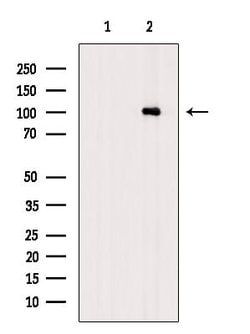

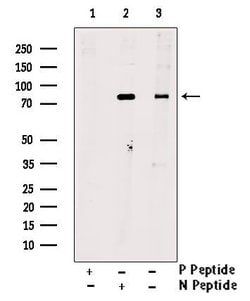
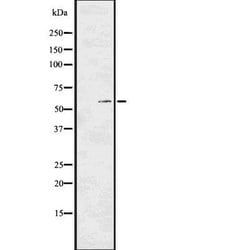
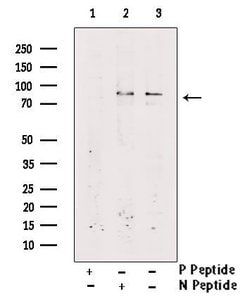
Description
- This antibody is predicted to react with human and rat based on sequence homology
- The PKC family of serine/threonine kinases, including PRKCN (PKD3), is activated intracellularly by signal transduction pathways
- In humans, at least 12 different PKC polypeptides have been identified
- These isoforms differ in primary structure, tissue distribution, subcellular localization, mode of action in vitro, response to extracellular signals, and substrate specificity
- PKC alpha, beta I, beta II and gamma form the conventional family; their activities are Ca2+- and phospholipid-dependent
- PKC mu activation is dependent on the phosphorylation of two activation loop sites, Ser744 and Ser748, via a PKC-dependent signaling pathway.