PA550325
Annexin A9 Polyclonal Antibody, Invitrogen™
Manufacturer: Thermo Scientific
Select a Size
| Pack Size | SKU | Availability | Price |
|---|---|---|---|
| Each of 1 | PA550325-Each-of-1 | In Stock | ₹ 48,104.50 |
PA550325 - Each of 1
In Stock
Quantity
1
Base Price: ₹ 48,104.50
GST (18%): ₹ 8,658.81
Total Price: ₹ 56,763.31
Antigen
Annexin A9
Classification
Polyclonal
Conjugate
Unconjugated
Gene
ANXA9
Gene Alias
1110003P15Rik; 2310069F17Rik; annexin 31; annexin A9; Annexin XXXI; annexin-31; Annexin-9; ANX31; Anxa9; Pemphaxin
Host Species
Rabbit
Purification Method
Antigen affinity chromatography
Regulatory Status
RUO
Gene ID (Entrez)
8416
Content And Storage
-20°C
Form
Liquid
Applications
Immunohistochemistry (Paraffin), Western Blot
Concentration
4 mg/mL
Formulation
PBS with 50% glycerol and 0.05% sodium azide; pH 7.3
Gene Accession No.
O76027
Gene Symbols
ANXA9
Immunogen
Full length fusion protein of Human ANXA9
Quantity
100 μL
Primary or Secondary
Primary
Target Species
Human
Product Type
Antibody
Isotype
IgG
Related Products
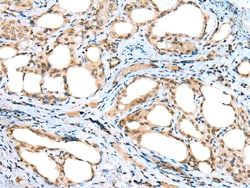

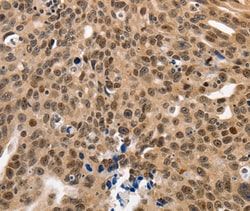

Description
- The antibody detects endogenous levels of total ANXA9 protein
- The annexins include ANXA9 coded protein, which are a family of calcium-dependent phospholipid-binding proteins
- Members of the annexin family contain 4 internal repeat domains, each of which includes a type II calcium-binding site
- The calcium-binding sites are required for annexins to aggregate and cooperatively bind anionic phospholipids and extracellular matrix proteins
- Annexin A9 is a divergent member of the annexin protein family in which all four homologous type II calcium-binding sites in the conserved tetrad core contain amino acid substitutions that ablate their function
- However, structural analysis suggests that the conserved putative ion channel formed by the tetrad core is intact.