CRIM1 Polyclonal Antibody, Invitrogen™
Manufacturer: Thermo Scientific
Select a Size
| Pack Size | SKU | Availability | Price |
|---|---|---|---|
| Each of 1 | PA550643-Each-of-1 | In Stock | ₹ 46,502.50 |
PA550643 - Each of 1
In Stock
Quantity
1
Base Price: ₹ 46,502.50
GST (18%): ₹ 8,370.45
Total Price: ₹ 54,872.95
Antigen
CRIM1
Classification
Polyclonal
Conjugate
Unconjugated
Gene
CRIM1
Gene Alias
AU015004; Crim1; CRIM-1; cysteine rich transmembrane BMP regulator 1; cysteine rich transmembrane BMP regulator 1 (chordin like); cysteine rich transmembrane BMP regulator 1 (chordin-like); cysteine-rich motor neuron 1; cysteine-rich motor neuron 1 protein; Cysteine-rich repeat-containing protein S52; Processed cysteine-rich motor neuron 1 protein; S52; UNQ1886/PRO4330
Host Species
Rabbit
Purification Method
Antigen affinity chromatography
Regulatory Status
RUO
Gene ID (Entrez)
51232
Content And Storage
-20°C
Form
Liquid
Applications
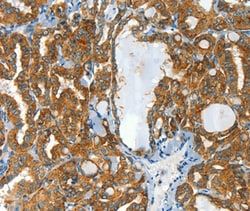
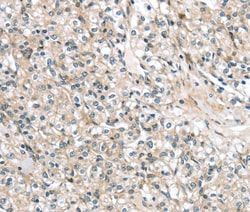
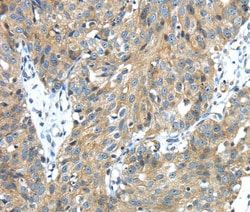
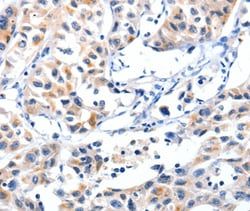
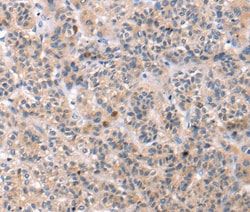
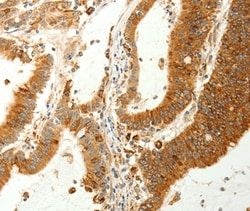
Immunohistochemistry (Paraffin)
Concentration
1.5 mg/mL
Formulation
PBS with 40% glycerol and 0.05% sodium azide; pH 7.4
Gene Accession No.
Q9NZV1
Gene Symbols
CRIM1
Immunogen
Synthetic peptide corresponding to a region derived from internal residues of human cysteine rich transmembrane BMP regulator 1 (chordin-like)
Quantity
100 μL
Primary or Secondary
Primary
Target Species
Human
Product Type
Antibody
Isotype
IgG
Related Products


Description
- The antibody detects endogenous levels of total CRIM1 protein
- CRIM1 (cysteine-rich motor neuron 1), a glycosylated type I transmembrane protein, plays a role in tissue development i.e
- capillary formation and maintenance during angiogenesis
- It contains an N-terminal IGF-binding protein-like motif and six von Willebrand-like cysteine-rich repeats (CRRs) in its extracellular domain
- CRIM1 interacts with BMP4 and BMP7 via the CRRs and functions as an antagonist
- CRIM1 is developmentally expressed in a number of tissues including the pancreas, kidney, placenta, brain and blood vessels
- CRIM1 may participate in CNS and placental development by interacting with growth factors involved in motor neuron differentiation and survival.