Nectin 3 Polyclonal Antibody, Invitrogen™
Manufacturer: Thermo Scientific
Select a Size
| Pack Size | SKU | Availability | Price |
|---|---|---|---|
| Each of 1 | PA551095-Each-of-1 | In Stock | ₹ 45,968.50 |
PA551095 - Each of 1
In Stock
Quantity
1
Base Price: ₹ 45,968.50
GST (18%): ₹ 8,274.33
Total Price: ₹ 54,242.83
Antigen
Nectin 3
Classification
Polyclonal
Conjugate
Unconjugated
Gene
NECTIN3
Gene Alias
2610301B19Rik; 3000002N23Rik; 4921513D19Rik; AA407785; AU016832; AW538082; CD113; CDW113; DKFZP566B0846; FLJ90624; nectin 3; nectin cell adhesion molecule 3; Nectin3; Nectin-3; poliovirus receptor-related 3; poliovirus receptor-related protein 3; PPR3; PRR3; PVRL3; PVRR3
Host Species
Rabbit
Purification Method
Antigen affinity chromatography
Regulatory Status
RUO
Gene ID (Entrez)
25945, 288124, 58998
Content And Storage
-20° C, Avoid Freeze/Thaw Cycles
Form
Liquid
Applications
Immunocytochemistry, Western Blot, Western Blot
Concentration
1 mg/mL
Formulation
PBS with 0.5% BSA, 50% glycerol and 0.02% sodium azide; pH 7.4
Gene Accession No.
Q9JLB9, Q9NQS3
Gene Symbols
NECTIN3
Immunogen
Synthesized peptide derived from the Internal region of human Nectin 3.
Quantity
100 μL
Primary or Secondary
Primary
Target Species
Human, Mouse, Rat
Product Type
Antibody
Isotype
IgG
Related Products
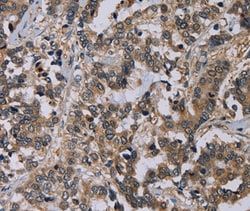
Description
- Nectin 3 / CD113 Polyclonal Antibody detects endogenous levels of Nectin 3 / CD113 protein
- Nectin-3 is a 83 kDa type I transmembrane glycoprotein
- Nectin, originally isolated as poliovirus receptor-related protein (PRR), is a cell-cell adhesion molecule of the immunoglobulin supergene family
- Nectins are calciumindependent immunoglobulin-like cell-cell adhesion molecules consisting of four members, nectin 1-4
- Nectins homophilically and heterophilically trans-interact to form a variety of cell-cell junctions, including cadherin-based adherens junctions in epithelial cells and fibroblasts in culture, synaptic junctions in neurons, and Sertoli cell-spermatid junctions in testis, in cooperation with, or independently of, cadherins
- Both nectin-2 and nectin-3 are ubiquitously expressed, whereas nectin-1 is abundantly expressed in brain
- Nectin-2 and -3 are expressed in cells where cadherin is not expressed, such as blood cells and spermatids
- All members of the nectin family have two or three splice variants
- For nectin-3, three isoforms exist: nectin-3 alpha, -3 beta and -3 gamma, of which nectin-3 alpha is the largest
- Nectin-3, also known as PRR3, is a transmembrane protein that is predominantly expressed in testis and placental tissues as well in many cell lines
- Nectin interacts in vivo with both long and short isoforms of afadin, an actin binding protein, at cadherin-based cell-cell adherence junctions in various tissues and cell lines
- Furthermore, the ectodomains of nectin-3 and CD155 (Poliovirus Receptor) have shown strong affinity to each other
- Injection of antibody 103-A1 into lumen of seminiferous tubules leads to disruption of the actin filaments in Sertoli cells at the Sertoli-maturing spermatid ectoplasmic specialization and exfoliation of maturing spermatids form the seminiferous epithelium.