Phospho-IR/IGF1R (Tyr1162, Tyr1163) Recombinant Rabbit Monoclonal Antibody (97H9L7), Invitrogen™
Manufacturer: Thermo Scientific
Select a Size
| Pack Size | SKU | Availability | Price |
|---|---|---|---|
| Each of 1 | PI700393-Each-of-1 | In Stock | ₹ 50,596.50 |
PI700393 - Each of 1
In Stock
Quantity
1
Base Price: ₹ 50,596.50
GST (18%): ₹ 9,107.37
Total Price: ₹ 59,703.87
Antigen
Phospho-IR/IGF1R (Tyr1162, Tyr1163)
Classification
Recombinant Monoclonal
Concentration
0.5 mg/mL
Formulation
PBS with 0.09% sodium azide
Gene Accession No.
P06213, P08069
Gene Symbols
IGF1R, Insr
Immunogen
A peptide corresponding to amino acids 1186-1197 and 1162-1173 of P06213 and P08069, respectively
Quantity
100 μg
Primary or Secondary
Primary
Target Species
Human
Product Type
Antibody
Isotype
IgG
Applications
ELISA, Western Blot
Clone
97H9L7
Conjugate
Unconjugated
Gene
IGF1R
Gene Alias
4932439J01Rik; A330103N21Rik; CD220; CD221; D630014A15Rik; D930020L01; HHF5; hyft; IGF1 Receptor; IGF-1 receptor; IGF1 Receptor beta; Igf1r; IGF-1R; IGF1R beta; IGF-I receptor; IGF-I Receptor beta; IGFIR; IGFIRC; IGFR; Igfr1; Insr; insulin like growth factor 1 receptor; insulin receptor; insulin receptor precursor; insulin receptor preproprotein; Insulin receptor subunit alpha; Insulin receptor subunit beta; Insulin-like growth factor 1 receptor; Insulin-like growth factor 1 receptor alpha chain; Insulin-like growth factor 1 receptor beta chain; insulin-like growth factor 1 receptor beta subunit; insulin-like growth factor I receptor; insulin-like growth factor receptor 1; insulin-like growth factor receptor type 1; insulin-like growth factor-I receptor; insulin-like growth factor-I receptor precursor; IR; IR-A; IR-B; JTK13; line 186; soluble IGF1R variant 1; soluble IGF1R variant 2
Host Species
Rabbit
Purification Method
Protein A
Regulatory Status
RUO
Gene ID (Entrez)
3480, 3643
Content And Storage
Store at 4°C short term. For long term storage, store at -20°C, avoiding freeze/thaw cycles.
Form
Liquid
Related Products
Description
- This antibody is predicted to react with bovine, canine, chicken, chimpanzee, equine, mouse, rat, Rhesus monkey , porcine and Xenopus based on sequence homology
- Intact IgG appears on a non-reducing gel as ∽150 kDa band and upon reduction generating a ∽25 kDa light chain band and a ∽50 kDa heavy chain
- Recombinant rabbit monoclonal antibodies are produced using in vitro expression systems
- The expression systems are developed by cloning in the specific antibody DNA sequences from immunoreactive rabbits
- Then, individual clones are screened to select the best candidates for production
- The advantages of using recombinant rabbit monoclonal antibodies include: better specificity and sensitivity, lot-to-lot consistency, animal origin-free formulations, and broader immunoreactivity to diverse targets due to larger rabbit immune repertoire
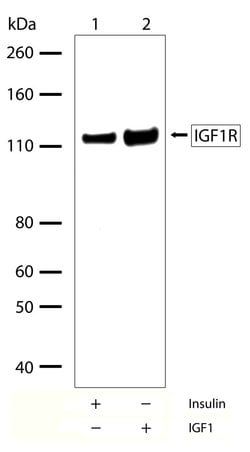
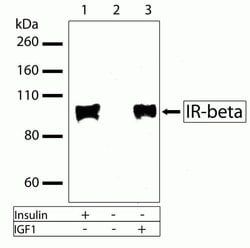
- Insulin and Insulin-like Growth Factor receptors are transmembrane tyrosine kinase receptors that play critical roles in development, cell growth and metabolism
- Insulin/Insulin-like growth factor-1 binding to the extracellular domain of IR and IGFR leads to autophosphorylation of the receptor and activation of the intrinsic tyrosine kinase activity, which allows appropriate substrates to be phosphorylated
- Phosphorylation sites that are unique to each receptor presumably play a key role in these signaling differences
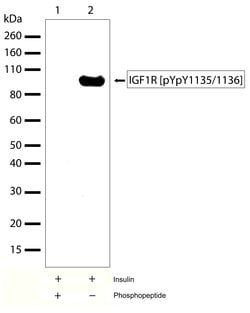
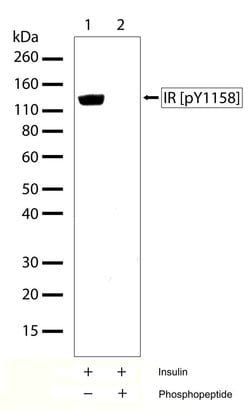
- The catalytic loops within the tyrosine kinase domains contain a three tyrosine motif corresponding to Tyr1158, 1162 and 1163 (for the IR) and Tyr1131, 1135 and 1136 (for the IGF1R)
- Autophosphorylation of the tyrosine sites within the activation loop proceeds in a processive manner initiating at the second tyrosine (1162 or 1135), followed by phosphorylation at tyrosines 1158 (IGF-1R tyrosine 1131), 1163 (IGF-1R tyrosine 1136), resulting in the full activation of IR and IGF1R.