CD8 Monoclonal Antibody (YTS169.4), Invitrogen™
Manufacturer: Thermo Scientific
Select a Size
| Pack Size | SKU | Availability | Price |
|---|---|---|---|
| Each of 1 | PIMA182375-Each-of-1 | In Stock | ₹ 38,092.00 |
PIMA182375 - Each of 1
In Stock
Quantity
1
Base Price: ₹ 38,092.00
GST (18%): ₹ 6,856.56
Total Price: ₹ 44,948.56
Antigen
CD8
Classification
Monoclonal
Concentration
1 mg/mL
Formulation
PBS with 0.09% sodium azide; pH 7.4
Gene Accession No.
P01731, P10300
Gene Symbols
Cd8a, Cd8b1
Immunogen
Proprietary Immunogen.
Quantity
250 μg
Primary or Secondary
Primary
Target Species
Mouse
Product Type
Antibody
Isotype
IgG2b
Applications
Flow Cytometry, Immunohistochemistry (Frozen)
Clone
YTS169.4
Conjugate
Unconjugated
Gene
Cd8a
Gene Alias
BB154331; CD8; CD8 alpha; CD8 alpha chain; CD8 alpha chain precursor; CD8 antigen; CD8 antigen 32 kDa chain; CD8 antigen 37 kDa chain; CD8 antigen alpha polypeptide; CD8 antigen alpha protein; CD8 antigen alpha protein precursor; CD8 antigen alpha-chain; CD8 antigen beta polypeptide; CD8 antigen beta polypeptide precursor; CD8 antigen beta-chain; CD8 antigen, alpha chain; CD8 antigen, alpha polypeptide; CD8 antigen, alpha polypeptide (p32); CD8 antigen, alpha-chain; CD8 antigen, beta chain; CD8 antigen, beta chain 1; CD8 antigen, beta polypeptide; CD8 antigen, beta polypeptide 1 (p37); CD8 antigen, beta-chain; CD8 beta; CD8 beta chain; CD8 beta-2; CD8a; CD8A antigen alpha; CD8a molecule; CD8A; T-cell surface glycoprotein; CD8alpha; CD8B; CD8b antigen; CD8b molecule; CD8b molecule pseudogene; Cd8b1; CD8beta; CD8BP; fCD8; LEU2; Leu-2; Leu2 T-lymphocyte antigen; leu-2a; Ly-2; LY3; Ly-3; Ly-35; Ly-B; Ly-C; Lymphocyte antigen 3; Lyt2; Lyt-2; Lyt-2.1 lymphocyte differentiation antigen (AA at 100); Lyt3; Lyt-3; MAL; membrane glycoprotein; membrane protein; OKT8 T-cell antigen; OX-8 membrane antigen; p32; P37; RHACD8-4; T cell co-receptor; T lymphocyte surface glycoprotein beta chain; T8 T-cell antigen; T-cell antigen Leu2; T-cell membrane glycoprotein Ly-3; T-cell surface glycoprotein; T-cell surface glycoprotein CD8 alpha chain; T-cell surface glycoprotein CD8 beta chain; T-cell surface glycoprotein Lyt-2; T-cell surface glycoprotein Lyt-3; T-cell surface molecule; T-lymphocyte differentiation antigen T8/Leu-2; type I transmembrane glycoprotein
Host Species
Rat
Purification Method
Protein G
Regulatory Status
RUO
Gene ID (Entrez)
12525, 12526
Content And Storage
Store at 4°C short term. For long term storage, store at -20°C, avoiding freeze/thaw cycles.
Form
Liquid
Related Products



Description
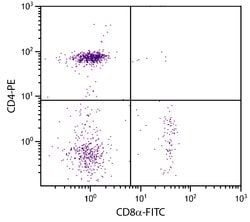
- For FACS analysis, use 10 μL of the suggested working dilution to label 1x10^6 cells in 100 μL
- Rat anti Mouse CD8 antibody, clone YTS169.4 recognizes the murine CD8 cell surface antigen, expressed by a subset of T lymphocytes.Rat anti Mouse CD8 antibody, clone YTS169.4 exhibits depleting activity when used in vivo
- Cluster of differentiation 8 (CD8), a type I transmembrane glycoprotein of the immunoglobulin family of receptors, plays an integral role in signal transduction, and T cell differentiation and activation
- CD8 is predominantly expressed on T cells as a disulfide-linked heterodimer of CD8alpha and CD8beta, where it functions as a co-receptor, along with T cell receptor (TCR), for major histocompatibilty complex class I (MHC-I) molecules; whereas its counterpart, CD4, acts as a co-receptor for MHC-II molecules
- CD8 exists on the cell surface, where the CD8alpha chain is essential for binding to MHC-I
- CD8 is also expressed on a subset of T cells, NK cells, monocytes and dendritic cells as disulfide-linked homodimers of CD8alpha
- Ligation of MHC-I/peptide complexes presented by antigen-presenting cells (APCs), triggers the recruitment of lymphocyte-specific protein tyrosine kinase (Lck), which leads to lymphokine production, motility and cytotoxic T lymphocyte (CTL) activation
- Once activated, CTLs play a crucial role in the clearance of pathogens and tumor cells
- Differentiation of naive CD8+ T cells into CTLs is strongly enhanced by IL-2, IL-12 and TGF-beta1.