Carbonic Anhydrase IX Monoclonal Antibody (SP106), Invitrogen™
Manufacturer: Thermo Scientific
Select a Size
| Pack Size | SKU | Availability | Price |
|---|---|---|---|
| Each of 1 | PIMA516413-Each-of-1 | In Stock | ₹ 59,363.00 |
PIMA516413 - Each of 1
In Stock
Quantity
1
Base Price: ₹ 59,363.00
GST (18%): ₹ 10,685.34
Total Price: ₹ 70,048.34
Antigen
Carbonic Anhydrase IX
Classification
Monoclonal
Concentration
0.11 mg/mL
Formulation
PBS with 1% BSA and 0.1% sodium azide; pH 7.2
Gene Accession No.
Q16790
Gene Symbols
CA9
Immunogen
Synthetic peptide derived from human CA-9.
Quantity
500 μL
Primary or Secondary
Primary
Target Species
Human
Product Type
Antibody
Isotype
IgG
Applications
Flow Cytometry, Immunohistochemistry (Paraffin), Western Blot
Clone
SP106
Conjugate
Unconjugated
Gene
CA9
Gene Alias
Ca9; CA-9; CAIX; CA-IX; Car9; Carbonate dehydratase IX; carbonic anhydrase 9; Carbonic anhydrase IX; carbonic dehydratase; G250; Membrane antigen MN; membrane antigen MN homolog; MN; MN/CA9; P54 / 58N; P54/58N; pMW1; RCC-associated antigen G250; RCC-associated protein G250; renal cell carcinoma-associated antigen G250
Host Species
Rabbit
Purification Method
Protein A/G
Regulatory Status
RUO
Gene ID (Entrez)
768
Content And Storage
4° C, do not freeze
Form
Liquid
Related Products
Description
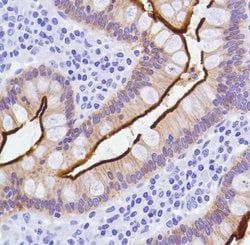
- Heat-mediated antigen retrieval is recommended prior to staining, using a 10mM citrate buffer, pH 6.0, for 10 minutes followed by cooling at room temperature for 20 min
- Following antigen retrieval, incubate samples with primary antibody for 10 min at room temperature
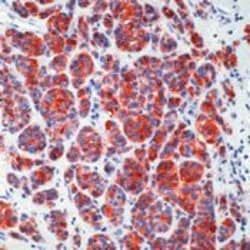
- A suggested positive control is stomach tissue
- Carbonic anhydrase (CA) is an enzyme that assists rapid interconversion of carbon dioxide and water into carbonic acid, protons, and bicarbonate ions
- It is abundant in all mammalian tissues
- There are many genes that are inducible by hypoxia, via HIF-1 alpha
- CA IX is one of the most inducible genes because of its stability and location within the membrane
- Carbonic anhydrases have a widespread role in regulating pH in normal tissues, by regulating hydrogen ion (H+) flux
- The pH is important in cell death under hypoxia, thus a blockade of CA IX results in increased cell death under hypoxia
- Therefore, CA IX has become a reliable histochemical marker of hypoxia.