GYPC Monoclonal Antibody (BRIC4), Invitrogen™
Manufacturer: Thermo Scientific
Select a Size
| Pack Size | SKU | Availability | Price |
|---|---|---|---|
| Each of 1 | PIMA516592-Each-of-1 | In Stock | ₹ 52,955.00 |
PIMA516592 - Each of 1
In Stock
Quantity
1
Base Price: ₹ 52,955.00
GST (18%): ₹ 9,531.90
Total Price: ₹ 62,486.90
Antigen
GYPC
Classification
Monoclonal
Concentration
0.5 mg/mL
Formulation
TBS with ≤100mM glycine and <0.1% sodium azide
Gene Accession No.
P04921
Gene Symbols
GYPC
Immunogen
Human erythrocytes
Quantity
200 μg
Primary or Secondary
Primary
Target Species
Human
Product Type
Antibody
Isotype
IgG1
Applications
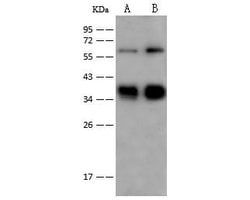
Flow Cytometry, Hemagglutination Assay, Immunohistochemistry (Frozen), Western Blot
Clone
BRIC4
Conjugate
Unconjugated
Gene
GYPC
Gene Alias
0610037F22Rik; CD236; CD236R; GE; Gerbich antigen; GLPC; Glycoconnectin; glycophorin C; glycophorin C (Gerbich blood group); glycophorin-C; Glycophorin-D; glycoprotein beta; GPC; GPD; GPYD; GYPC; GYPD; MGC117309; MGC126191; MGC126192; PAS-2; PAS-2'; Sialoglycoprotein D
Host Species
Mouse
Purification Method
Protein G
Regulatory Status
RUO
Gene ID (Entrez)
2995
Content And Storage
Store at 4°C short term. For long term storage, store at -20°C, avoiding freeze/thaw cycles.
Form
Liquid
Related Products


Description
- For FACS analysis, use 10 μL of the suggested working dilution to label 1x10^6 cells in 100 μL
- Glycophorin C (GYPC) is an integral membrane glycoprotein
- It is a minor species carried by human erythrocytes, but plays an important role in regulating the mechanical stability of red cells
- A number of glycophorin C mutations have been described
- The Gerbich and Yus phenotypes are due to deletion of exon 3 and 2, respectively
- The Webb and Duch antigens, also known as glycophorin D, result from single point mutations of the glycophorin C gene
- The glycophorin C protein has very little homology with glycophorins A and B.