NDUFB9 Monoclonal Antibody (OTI8B7), Invitrogen™
Manufacturer: Thermo Scientific
Select a Size
| Pack Size | SKU | Availability | Price |
|---|---|---|---|
| Each of 1 | PIMA525458-Each-of-1 | In Stock | ₹ 52,198.50 |
PIMA525458 - Each of 1
In Stock
Quantity
1
Base Price: ₹ 52,198.50
GST (18%): ₹ 9,395.73
Total Price: ₹ 61,594.23
Antigen
NDUFB9
Classification
Monoclonal
Concentration
0.76 mg/mL
Formulation
PBS with 1% BSA, 50% glycerol and 0.02% sodium azide; pH 7.3
Gene Accession No.
Q9Y6M9
Gene Symbols
Ndufb9
Immunogen
Human fragment corresponding to amino acids 3-179 of NDUFB9 produced in E.coli
Quantity
100μL
Primary or Secondary
Primary
Target Species
Human, Non-human Primate
Product Type
Antibody
Isotype
IgG2b
Applications
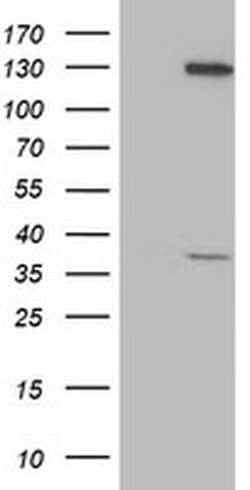
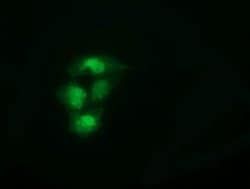
Flow Cytometry, Western Blot
Clone
OTI8B7
Conjugate
Unconjugated
Gene
Ndufb9
Gene Alias
1190008J14Rik; B22; CI-B22; complex I B22 subunit; complex I-B22; EGK_19260; LYR motif-containing protein 3; LYRM3; NADH dehydrogenase (ubiquinone) 1 beta subcomplex, 9; NADH dehydrogenase (ubiquinone) 1 beta subcomplex, 9, 22kDa; NADH dehydrogenase [ubiquinone] 1 beta subcomplex subunit 9; NADH:ubiquinone oxidoreductase subunit B9; NADH-ubiquinone oxidoreductase B22 subunit; NDUFB9; UQOR22
Host Species
Mouse
Purification Method
Affinity Chromatography
Regulatory Status
RUO
Gene ID (Entrez)
4715
Content And Storage
-20° C, Avoid Freeze/Thaw Cycles
Form
Liquid
Related Products
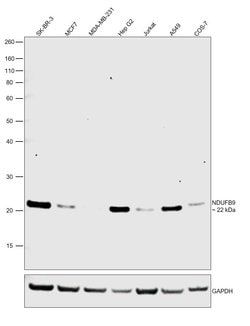
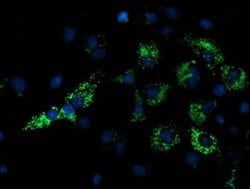
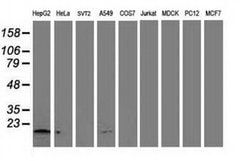
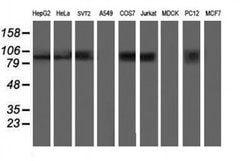


Description
- LYRM3, also known as NADH dehydrogenase (ubiquinone) 1 beta subcomplex 9 (NDUFB9), is a ubiquitously expressed LYR-motif containing protein
- It has been suggested to be a candidate gene for the branchio-oto-renal (BOR) syndrome, which is characterized by branchial and renal abnormalities and heredity deafness disorders
- Other than its LYR-motif, LYRM3 appears to have no functional or structural relationship to either LYRM1 or LYRM2.