GSTO2 Monoclonal Antibody (OTI3A9), Invitrogen™
Manufacturer: Thermo Scientific
Select a Size
| Pack Size | SKU | Availability | Price |
|---|---|---|---|
| Each of 1 | PIMA525815-Each-of-1 | In Stock | ₹ 52,198.50 |
PIMA525815 - Each of 1
In Stock
Quantity
1
Base Price: ₹ 52,198.50
GST (18%): ₹ 9,395.73
Total Price: ₹ 61,594.23
Antigen
GSTO2
Classification
Monoclonal
Concentration
0.62 mg/mL
Formulation
PBS with 1% BSA, 50% glycerol and 0.02% sodium azide; pH 7.3
Gene Accession No.
Q9H4Y5
Gene Symbols
Gsto2
Immunogen
Full length human recombinant protein of GSTO2 produced in HEK293T cell
Quantity
100μL
Primary or Secondary
Primary
Target Species
Human
Product Type
Antibody
Isotype
IgG1
Applications
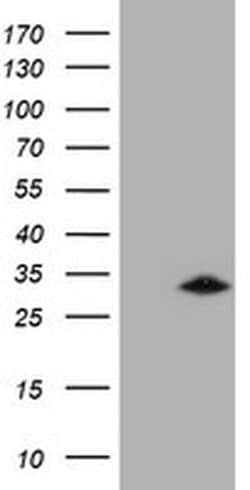
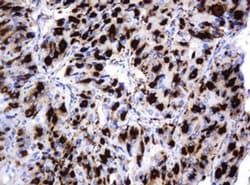
Immunohistochemistry (Paraffin), Western Blot
Clone
OTI3A9
Conjugate
Unconjugated
Gene
Gsto2
Gene Alias
1700020F09Rik; 4930425C18Rik; bA127L20.1; bA127L20.1 (novel glutathione-S-transferase); glutathione S-transferase omega 2; glutathione S-transferase omega 2-2; Glutathione S-transferase omega-2; glutathione-dependent dehydroascorbate reductase; glutathione-S-transferase-like protein; GSTO 2-2; Gsto2; GSTO-2; LOC100720364; MMA(V) reductase; monomethylarsonic acid reductase
Host Species
Mouse
Purification Method
Affinity Chromatography
Regulatory Status
RUO
Gene ID (Entrez)
119391
Content And Storage
-20° C, Avoid Freeze/Thaw Cycles
Form
Liquid
Related Products


Description
- The omega class glutathione transferases (GST; EC 2.5.1.18) have poor activity with common GST substrates, but exhibit novel glutathione-dependent thioltransferase, dehydroascorbate reductase, and monomethylarsonate reductase activities, and they modulate Ca(2+) release by ryanodine receptors (e.g., RYR1).