PIMA526594
Macro H2A.2 Monoclonal Antibody (OTI1F5), Invitrogen™
Manufacturer: Thermo Scientific
Select a Size
| Pack Size | SKU | Availability | Price |
|---|---|---|---|
| Each of 1 | PIMA526594-Each-of-1 | In Stock | ₹ 52,198.50 |
PIMA526594 - Each of 1
In Stock
Quantity
1
Base Price: ₹ 52,198.50
GST (18%): ₹ 9,395.73
Total Price: ₹ 61,594.23
Antigen
Macro H2A.2
Classification
Monoclonal
Concentration
1 mg/mL
Formulation
PBS with 1% BSA, 50% glycerol and 0.02% sodium azide; pH 7.3
Gene Accession No.
Q9P0M6
Gene Symbols
H2AFY2
Immunogen
Human recombinant protein fragment corresponding to amino acids 2-261 of H2AFY2 produced in E.coli
Quantity
100μL
Primary or Secondary
Primary
Target Species
Human
Product Type
Antibody
Isotype
IgG2a
Applications
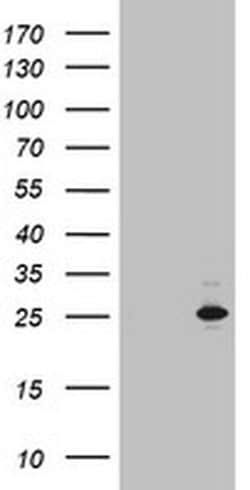
Immunohistochemistry (Paraffin), Western Blot
Clone
OTI1F5
Conjugate
Unconjugated
Gene
H2AFY2
Gene Alias
Core histone macro-H2A.2; core histone macroH2A2.2; H2A histone family member Y2; H2A histone family, member Y2; H2AFY2; H2afy3; Histone macroH2A2; histone mH2A2; macroH2A2; mH2A2; RGD1561371
Host Species
Mouse
Purification Method
Affinity Chromatography
Regulatory Status
RUO
Gene ID (Entrez)
55506
Content And Storage
-20° C, Avoid Freeze/Thaw Cycles
Form
Liquid
Related Products
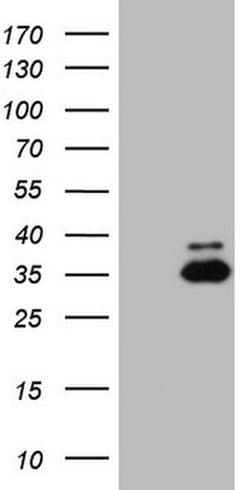


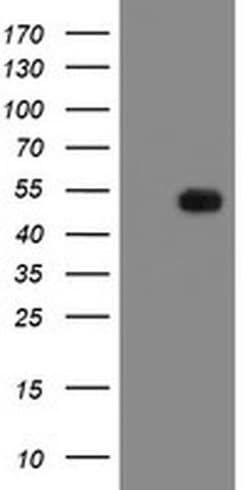
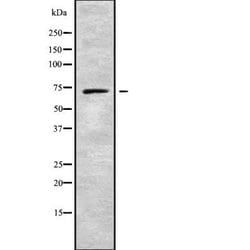
Description
- Variant histone H2A which replaces conventional H2A in a subset of nucleosomes where it represses transcription
- Nucleosomes wrap and compact DNA into chromatin, limiting DNA accessibility to the cellular machineries which require DNA as a template
- Histones thereby play a central role in transcription regulation, DNA repair, DNA replication and chromosomal stability
- DNA accessibility is regulated via a complex set of post-translational modifications of histones, also called histone code, and nucleosome remodeling
- May be involved in stable X chromosome inactivation.