POMK Monoclonal Antibody (OTI2B10), Invitrogen™
Manufacturer: Thermo Scientific
Select a Size
| Pack Size | SKU | Availability | Price |
|---|---|---|---|
| Each of 1 | PIMA526678-Each-of-1 | In Stock | ₹ 52,198.50 |
PIMA526678 - Each of 1
In Stock
Quantity
1
Base Price: ₹ 52,198.50
GST (18%): ₹ 9,395.73
Total Price: ₹ 61,594.23
Antigen
POMK
Classification
Monoclonal
Concentration
1 mg/mL
Formulation
PBS with 1% BSA, 50% glycerol and 0.02% sodium azide; pH 7.3
Gene Accession No.
Q9H5K3
Gene Symbols
POMK
Immunogen
Human recombinant protein fragment corresponding to amino acids 141-350 of SGK196 produced in E.coli
Quantity
100μL
Primary or Secondary
Primary
Target Species
Human
Product Type
Antibody
Isotype
IgG1
Applications
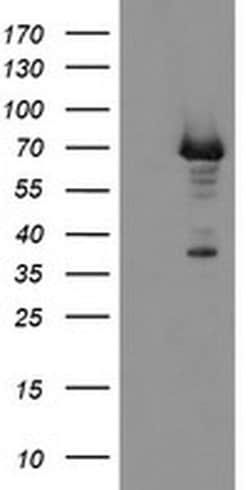
Immunohistochemistry (Paraffin), Western Blot
Clone
OTI2B10
Conjugate
Unconjugated
Gene
POMK
Gene Alias
4930444A02Rik; MDDGA12; MDDGC12; Pomk; probable inactive protein kinase-like protein SgK196; protein kinase-like protein SgK196; protein kinase-like protein SgK196-like; protein O-mannose kinase; protein-O-mannose kinase; RGD1310810; SGK196; sugen kinase 196
Host Species
Mouse
Purification Method
Affinity Chromatography
Regulatory Status
RUO
Gene ID (Entrez)
84197
Content And Storage
-20° C, Avoid Freeze/Thaw Cycles
Form
Liquid
Related Products


Description
- This gene encodes a protein that may be involved in the presentation of the laminin-binding O-linked carbohydrate chain of alpha-dystroglycan (a-DG), which forms transmembrane linkages between the extracellular matrix and the exoskeleton
- Some pathogens use this O-linked carbohydrate unit for host entry
- Loss of function compound heterozygous mutations in this gene were found in a human patient affected by the Walker-Warburg syndrome (WWS) phenotype
- Mice lacking this gene contain misplaced neurons (heterotopia) in some regions of the brain, possibly from defects in neuronal migration
- Alternative splicing of this gene results in multiple transcript variants.