DMRT1 Monoclonal Antibody (OTI4E12), Invitrogen™
Manufacturer: Thermo Scientific
Select a Size
| Pack Size | SKU | Availability | Price |
|---|---|---|---|
| Each of 1 | PIMA526903-Each-of-1 | In Stock | ₹ 52,198.50 |
PIMA526903 - Each of 1
In Stock
Quantity
1
Base Price: ₹ 52,198.50
GST (18%): ₹ 9,395.73
Total Price: ₹ 61,594.23
Antigen
DMRT1
Classification
Monoclonal
Concentration
1 mg/mL
Formulation
PBS with 1% BSA, 50% glycerol and 0.02% sodium azide; pH 7.3
Gene Accession No.
Q9Y5R6
Gene Symbols
DMRT1
Immunogen
Human recombinant protein fragment corresponding to amino acids 1-210 of DMRT1 produced in E.coli
Quantity
100μL
Primary or Secondary
Primary
Target Species
Human
Product Type
Antibody
Isotype
IgG2b
Applications
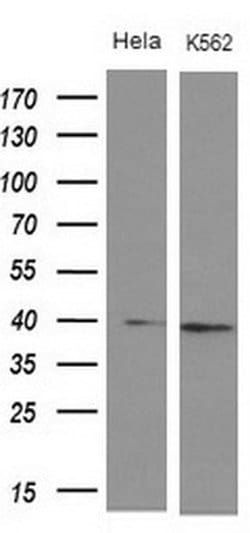
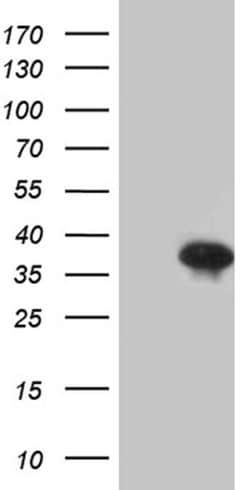
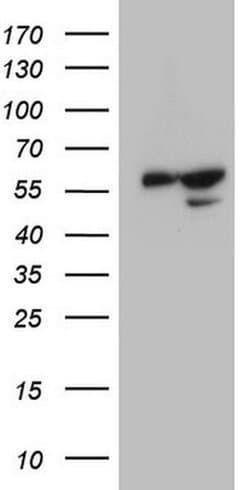
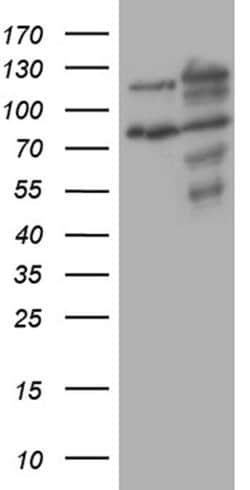
Immunohistochemistry (Paraffin), Western Blot
Clone
OTI4E12
Conjugate
Unconjugated
Gene
DMRT1
Gene Alias
CT154; DM domain expressed in testis 1; DM domain expressed in testis protein 1; Dmrt1; DMT1; Doublesex and mab-3 related transcription factor 1; doublesex- and mab-3-related transcription factor 1; Unknown (protein for MGC:134119)
Host Species
Mouse
Purification Method
Affinity Chromatography
Regulatory Status
RUO
Gene ID (Entrez)
1761
Content And Storage
-20° C, Avoid Freeze/Thaw Cycles
Form
Liquid
Related Products
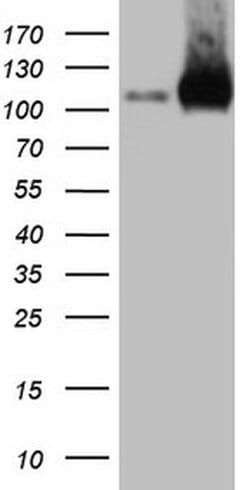
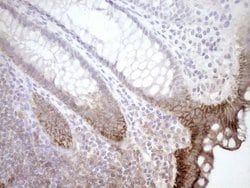

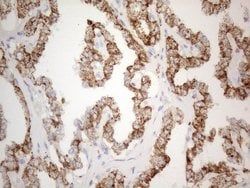
Description
- This gene is found in a cluster with two other members of the gene family, having in common a zinc finger-like DNA-binding motif (DM domain)
- The DM domain is an ancient, conserved component of the vertebrate sex-determining pathway that is also a key regulator of male development in flies and nematodes
- This gene exhibits a gonad-specific and sexually dimorphic expression pattern
- Defective testicular development and XY feminization occur when this gene is hemizygous.