MAD4 Monoclonal Antibody (OTI7F7), Invitrogen™
Manufacturer: Thermo Scientific
Select a Size
| Pack Size | SKU | Availability | Price |
|---|---|---|---|
| Each of 1 | PIMA527071-Each-of-1 | In Stock | ₹ 52,198.50 |
PIMA527071 - Each of 1
In Stock
Quantity
1
Base Price: ₹ 52,198.50
GST (18%): ₹ 9,395.73
Total Price: ₹ 61,594.23
Antigen
MAD4
Classification
Monoclonal
Concentration
1 mg/mL
Formulation
PBS with 1% BSA, 50% glycerol and 0.02% sodium azide; pH 7.3
Gene Accession No.
Q14582
Gene Symbols
MXD4
Immunogen
Full length human recombinant protein of MXD4 produced in E.coli
Quantity
100μL
Primary or Secondary
Primary
Target Species
Human
Product Type
Antibody
Isotype
IgG2b
Applications
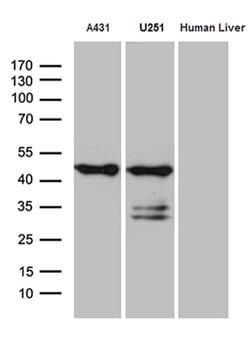
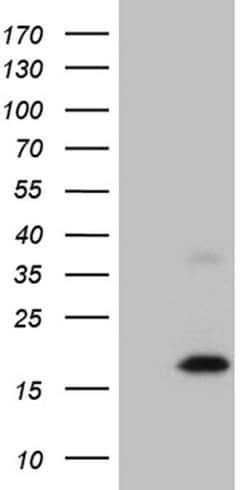
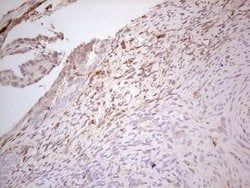
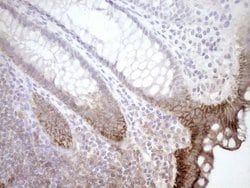
Immunohistochemistry (Paraffin), Western Blot
Clone
OTI7F7
Conjugate
Unconjugated
Gene
MXD4
Gene Alias
2810410A03Rik; bHLHc12; Class C basic helix-loop-helix protein 12; LOW QUALITY PROTEIN: max dimerization protein 4; MAD4; Mad4 homolog; max dimerization protein 4; Max dimerizer 4; max-associated protein 4; Max-interacting transcriptional repressor MAD4; MST149; MSTP149; MXD4
Host Species
Mouse
Purification Method
Affinity Chromatography
Regulatory Status
RUO
Gene ID (Entrez)
10608
Content And Storage
-20° C, Avoid Freeze/Thaw Cycles
Form
Liquid
Related Products
Description
- This gene is a member of the MAD gene family
- The MAD genes encode basic helix-loop-helix-leucine zipper proteins that heterodimerize with MAX protein, forming a transcriptional repression complex
- The MAD proteins compete for MAX binding with MYC, which heterodimerizes with MAX forming a transcriptional activation complex
- Studies in rodents suggest that the MAD genes are tumor suppressors and contribute to the regulation of cell growth in differentiating tissues.